
What Is Retatrutide (RETA)? Understanding the Triple Agonist Approach

By Shaun · Published November 18, 2026 · 8 min read
Listen to this article
Device narration · estimated timeline
Device narration · voice quality depends on your browser and installed voices.

Quick Answer
Retatrutide (RETA) is an investigational peptide designed to activate three hormone receptors at once: GLP-1, GIP and glucagon. It is in Phase 3 metabolic and obesity research. As of November 2026 it is not approved by Australia's TGA, and its mechanism alone does not establish superiority over other approaches.
Key Takeaways
- Retatrutide is a triple agonist: one molecule targeting GLP-1, GIP and glucagon receptors.
- GLP-1 and GIP are incretin pathways; glucagon adds an energy-mobilisation pathway beyond them.
- Tirzepatide targets two of these receptors; retatrutide adds the glucagon receptor.
- Phase 3 TRIUMPH trials study obesity and related conditions; long-term safety data are still developing.
- Retatrutide is investigational and not authorized by Health Canada; online products carry serious safety risks.
Introduction: A New Direction in Metabolic Research
Metabolic research is slowly moving beyond the study of single hormone pathways. Scientists are increasingly curious about how several receptor systems talk to one another to shape energy balance, glucose regulation, appetite signalling and metabolic activity.
One compound drawing a great deal of quiet attention is retatrutide (RETA), an investigational peptide designed to activate three distinct hormone receptors involved in metabolic regulation.
Unlike compounds that target a single receptor, or pair two hormonal pathways, retatrutide is studied for its ability to activate the GLP-1, GIP and glucagon receptors simultaneously. This three-pathway approach is known as triple agonism.
So what exactly is retatrutide? What does each of these receptors do? And why is activating all three at once generating such interest? Let's walk through it together, gently and carefully.
If you'd like a little grounding first, explore how peptides work at a scientific level, or read our side-by-side look at retatrutide vs. tirzepatide.
What Is Retatrutide?
Retatrutide is an investigational peptide that acts as a triple hormone receptor agonist, targeting the GLP-1, GIP and glucagon receptors. These receptors are associated with several physiological processes, including:
- Glucose homeostasis
- Appetite regulation and satiety signalling
- Energy expenditure
- Nutrient metabolism
- Gastrointestinal hormonal signalling
Rather than focusing on one biological signal, the compound is designed to engage three receptor systems that play different, but overlapping, roles in metabolic physiology.
| Characteristic | Description |
|---|---|
| Compound | Retatrutide |
| Common abbreviation | RETA |
| Research classification | Investigational peptide |
| Mechanism | Triple receptor agonism |
| Target receptors | GLP-1, GIP and glucagon |
| Research focus | Metabolic regulation and obesity |
| Status | Investigational; not an approved medicine in Canada |
Part of retatrutide's charm for researchers is that it brings together pathways traditionally explored separately, raising lovely questions about how coordinated hormonal signalling may influence whole-body metabolic function.
What Does Triple Agonist Mean?
A triple agonist is a molecule capable of activating three different receptor targets. Think of each receptor as a small doorbell on a cell's surface; retatrutide is designed to ring three of them. In retatrutide research, these targets are:
- GLP-1 receptor (glucagon-like peptide-1 receptor) — associated with glucose-dependent insulin secretion, appetite-related signalling and gastrointestinal regulation.
- GIP receptor (glucose-dependent insulinotropic polypeptide receptor) — involved in incretin signalling, insulin secretion and metabolic responses after nutrient intake.
- Glucagon receptor (GCGR) — plays a role in energy regulation, hepatic glucose metabolism and nutrient mobilisation.
The central research question is how these pathways interact when stimulated together, rather than one at a time. Tap through each receptor below to see how they differ.
Three receptors, one molecule
GLP-1 receptor · Incretin pathway
- 01Glucose-dependent insulin secretion
- 02Gastric emptying
- 03Appetite & satiety signalling
- Tirzepatide (dual)
- Targets this receptor
- Retatrutide (triple)
- Targets this receptor
Simplified research associations. Receptor activity alone does not predict clinical outcomes, safety or effectiveness.
Understanding the Three Hormone Receptors
1. GLP-1: Glucose Regulation and Appetite Signalling
The GLP-1 receptor is a cornerstone of incretin biology. GLP-1 is released in response to nutrient intake and helps regulate glucose metabolism. Its signalling is involved in:
- Glucose-dependent insulin secretion
- Regulation of glucagon secretion under certain physiological conditions
- Gastric emptying
- Appetite and satiety signalling
- Glucose homeostasis
It is widely studied because it gracefully connects gastrointestinal hormone signalling with pancreatic function and appetite regulation. Within retatrutide's design, GLP-1 activation is one part of a broader strategy.
2. GIP: The Incretin Pathway Beyond GLP-1
GIP is another incretin hormone released after nutrient intake. Its receptor contributes to glucose-dependent insulin secretion, but its biology is more nuanced than its name suggests, with research exploring its effects across different tissues and metabolic states. Researchers are interested in:
- How GIP receptor activation interacts with GLP-1 activity
- The role of GIP in nutrient-related hormonal responses
- GIP receptor signalling in adipose and other metabolic tissues
- How dual incretin pathways behave alongside additional receptor targets
3. Glucagon: Energy Mobilisation and Metabolic Regulation
Glucagon is traditionally associated with keeping blood glucose steady, particularly during fasting. Its receptor signalling is involved in:
- Hepatic glucose production
- Glycogen metabolism
- Mobilisation of stored energy
- Regulation of substrate utilisation
- Metabolic responses during fasting
This is the most distinctive part of retatrutide's design, because it steps beyond the incretin family. Scientists are investigating how glucagon receptor activity may contribute to energy balance when combined with GLP-1 and GIP signalling.
How Retatrutide's Triple Agonist Mechanism Works
Retatrutide's mechanism can be understood as an attempt to coordinate three receptor pathways that influence different aspects of metabolic physiology: nutrient processing, appetite, glucose regulation and energy metabolism.
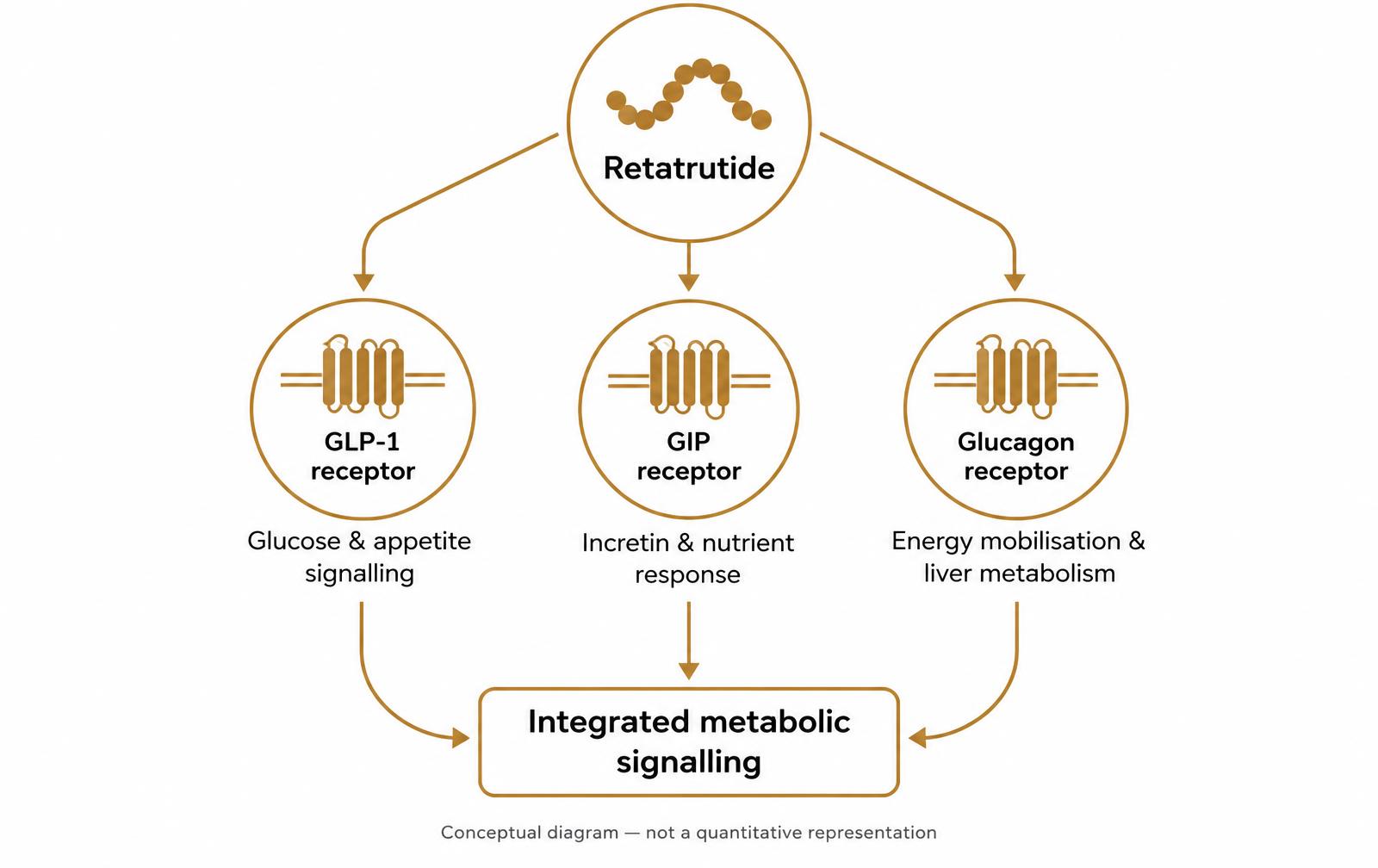
It is not simply a matter of adding three independent effects. Receptor signalling can interact, vary across tissues and depend on the physiological state of the organism. Understanding those interactions is a central part of ongoing research.
Retatrutide vs. Single and Dual Agonists
Metabolic peptide development has increasingly explored compounds that target several hormonal pathways. The progression from single- to multi-target approaches gives helpful context.
| Research Approach | Receptor Targets |
|---|---|
| Single agonist | One primary receptor target |
| Dual agonist | Two receptor targets |
| Triple agonist | Three receptor targets |
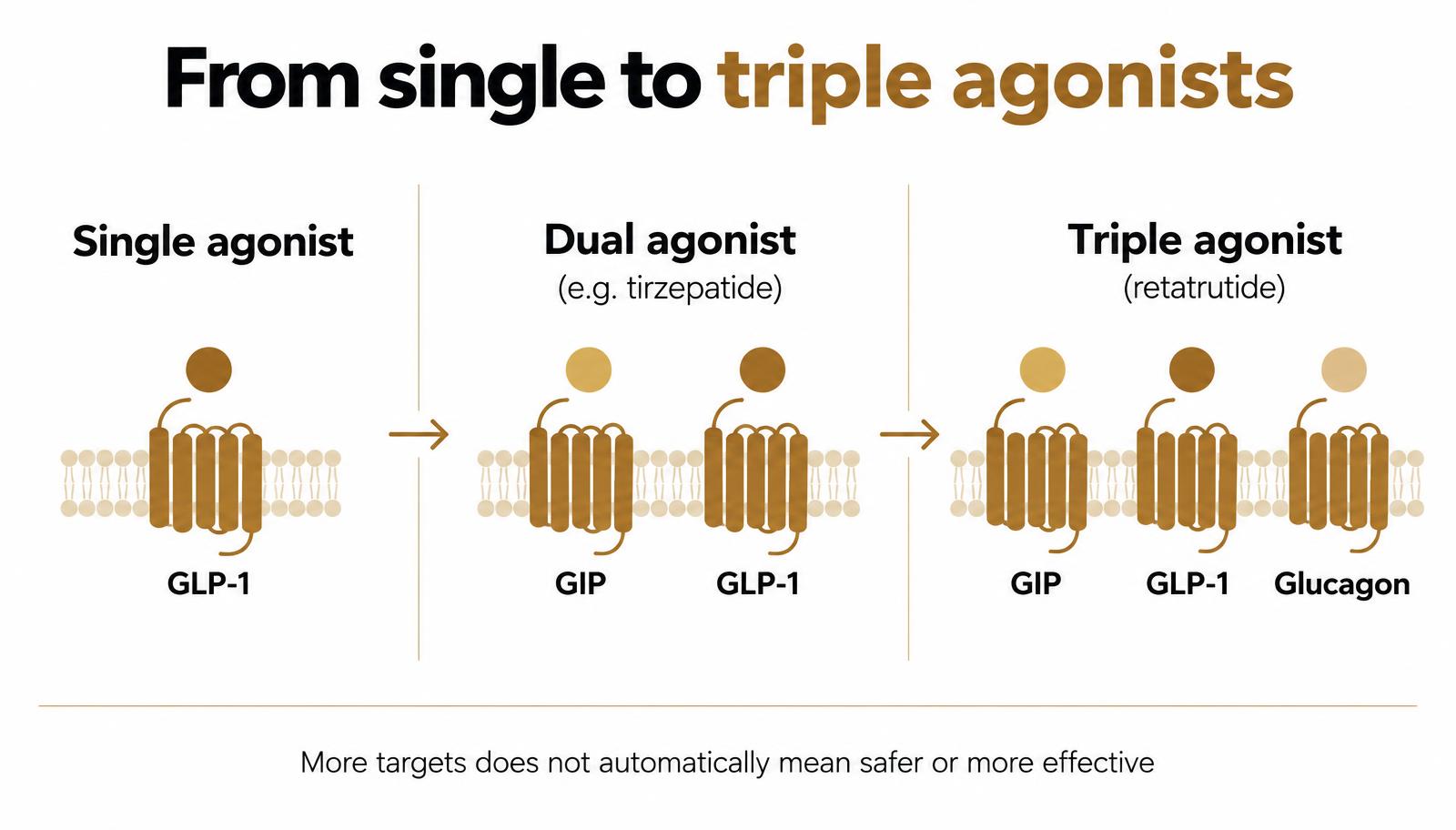
Multi-agonist research is driven by the understanding that metabolic regulation involves many interconnected systems. Targeting more than one pathway lets researchers investigate how these systems interact and whether broader receptor activation influences complex metabolic outcomes.
Targeting more receptors does not automatically make a compound safer, more effective or superior in every circumstance. Those questions require controlled clinical evidence.
What Is the Scientific Rationale Behind Triple Receptor Activation?
Appetite regulation, glucose metabolism, energy storage and nutrient utilisation do not operate independently. The rationale behind triple agonism is to investigate whether stimulating several hormone pathways together produces a coordinated response across these systems.
| Theme | Pathways involved | Research question |
|---|---|---|
| Appetite and satiety | GLP-1 (with GIP and glucagon context) | How do combined signals shape food-intake-related signalling and energy balance? |
| Glucose homeostasis | GLP-1 and GIP incretins, glucagon | How do incretin pathways interact with glucagon receptor signalling? |
| Energy metabolism | Glucagon | How might energy mobilisation complement incretin signalling? |
| Integrated effects | All three | How do three receptor systems influence outcomes when activated by one molecule? |
These mechanisms are complex. Receptor activity alone cannot predict clinical outcomes, and effects observed in human studies must be evaluated independently of theoretical mechanisms.
What Does Clinical Research Tell Us About Retatrutide?
Retatrutide has progressed from early clinical investigation into a broader Phase 3 programme. Research has explored populations with obesity or overweight, type 2 diabetes and related conditions. The distinction between research stages matters:
| Stage | Primary purpose |
|---|---|
| Preclinical | Investigates biological mechanisms and activity before human testing |
| Phase 1 | Examines safety, tolerability and pharmacological characteristics |
| Phase 2 | Explores efficacy, dose-related responses and further safety information |
| Phase 3 | Evaluates efficacy and safety in larger populations to support regulatory assessment |
For example, the TRIUMPH-1 trial investigated retatrutide in adults with obesity without diabetes, with additional study groups examining knee osteoarthritis pain and obstructive sleep apnea. Endpoints may include body weight, glycaemic measures, symptom-specific outcomes, tolerability and adverse events.
Results should always be read in light of the particular trial population, duration, endpoint and statistical analysis. One study's findings cannot automatically be applied to every individual or condition.
Retatrutide Research: Key Areas of Investigation
| Area | What researchers examine |
|---|---|
| Obesity and body weight | Changes in body weight and related metabolic markers |
| Type 2 diabetes | Glycaemic outcomes such as HbA1c, alongside weight-related endpoints |
| Knee osteoarthritis | Pain and functional outcomes in participants with obesity |
| Obstructive sleep apnea | Sleep-related respiratory outcomes in participants with obesity |
| Liver and cardiometabolic health | Liver-related, cardiovascular and renal outcomes |
These areas show why retatrutide is studied as a multi-pathway metabolic compound rather than simply as an appetite-related molecule.
Retatrutide vs. Tirzepatide: What Is the Difference?
The primary distinction is the number of receptor targets.
| Feature | Tirzepatide | Retatrutide |
|---|---|---|
| Receptor targets | GIP + GLP-1 | GIP + GLP-1 + glucagon |
| Research classification | Dual agonist | Triple agonist |
| Glucagon receptor target | No | Yes |
| Status | Approved medicine for specific indications | Investigational |
The added glucagon target is retatrutide's defining feature, yet mechanistic differences do not establish superiority; direct comparative clinical evidence is required. For a fuller look, read Retatrutide vs. Tirzepatide: What Does the Research Say?.
What Are the Limitations of Retatrutide Research?
- Long-term safety — information continues to develop; longer follow-up and broader participant data are needed.
- Receptor interaction complexity — three pathways may interact in ways that are hard to predict from single-receptor studies.
- Individual variability — genetics, medical history, baseline metabolic status and lifestyle can all shape responses.
- Clinical relevance — a measurable change in an endpoint does not translate into the same benefit for everyone.
- Regulatory status — trial findings do not mean a molecule is approved; regulators independently assess quality, safety and efficacy.
Is Retatrutide Authorized in Canada?
As of November 2026, retatrutide is investigational and has not been authorized by Health Canada. Its availability within clinical trials does not mean it is approved for general medical use.
Regulators, including Health Canada and Australia's TGA, have issued safety alerts about products sold online as retatrutide, including counterfeit products and products with undeclared ingredients. Do not use unapproved peptide products, and seek advice from a qualified healthcare professional. A research disclaimer or "not for human use" label does not automatically exempt a product from Canadian regulatory requirements.
Health Canada regulates drugs and their importation, sale and advertising under the Food and Drugs Act. For the latest information, check Health Canada's Drug Product Database and recalls and safety alerts.
The Future of Triple Agonist Research
Earlier approaches often focused on individual hormone pathways; newer strategies explore how several signals may be coordinated within one molecule. As research continues, scientists will be looking beyond short-term endpoints to understand:
- Long-term metabolic outcomes
- Safety and tolerability across different populations
- The role of glucagon receptor activity in multi-agonist biology
- Changes in body composition and metabolic markers
- Cardiometabolic outcomes over extended periods
- How triple agonism compares with established therapeutic approaches
Retatrutide's future significance will ultimately depend on the totality of clinical evidence, regulatory assessment and its demonstrated safety and efficacy.
Conclusion
Retatrutide (RETA) is a fascinating window into triple hormone receptor agonism. By targeting GLP-1, GIP and glucagon receptors together, it offers scientists a distinct way to explore interconnected metabolic pathways.
Its importance lies not only in its three targets, but in the questions surrounding them: how these pathways interact, how they influence outcomes, and what future research may reveal. For researchers and the scientifically curious alike, understanding its mechanism is lovely context for the wider evolution of peptide and metabolic science.
HelixForge Research publishes research-focused educational content on peptide science, molecular biology and emerging developments in metabolic research. This article is not medical advice.
Frequently asked questions
What is retatrutide?
Retatrutide is an investigational peptide designed to activate three hormone receptors: GLP-1, GIP and glucagon. It is being studied for its potential effects on metabolic regulation and obesity-related outcomes.
What does triple agonist mean in retatrutide research?
It means the molecule targets and activates three receptor systems — GLP-1, GIP and glucagon — associated with glucose regulation, appetite signalling and energy metabolism.
How is retatrutide different from tirzepatide?
Tirzepatide targets GIP and GLP-1 receptors, while retatrutide targets GIP, GLP-1 and glucagon receptors. The additional glucagon receptor target is the primary mechanistic difference.
What are GLP-1, GIP and glucagon?
They are hormones involved in metabolic regulation. GLP-1 and GIP are incretins associated with nutrient-related signalling and glucose-dependent insulin secretion; glucagon plays a role in glucose homeostasis and energy mobilisation.
What is retatrutide being studied for?
Clinical studies are investigating retatrutide in obesity, type 2 diabetes and related conditions, including knee osteoarthritis pain, obstructive sleep apnea and other cardiometabolic outcomes.
Is retatrutide approved in Canada?
No. As of November 2026, retatrutide has not been authorized by Health Canada and remains investigational.
Is retatrutide available for general use?
No. It is an investigational medicine and is not approved for general use. Products marketed outside authorised clinical research settings may pose serious safety and quality risks.
Why is retatrutide attracting scientific interest?
Its triple-receptor mechanism combines incretin signalling with glucagon receptor activity, giving researchers a way to study interactions among several metabolic pathways using one molecule.
References
- Peptide products, Therapeutic Goods Administration (TGA)
- TGA tests counterfeit retatrutide product following serious adverse event report, Therapeutic Goods Administration (TGA)
- Triple–Hormone-Receptor Agonist Retatrutide for Obesity — A Phase 2 Trial, New England Journal of Medicine (Jastreboff et al., 2023)
- Retatrutide clinical studies (TRIUMPH programme), ClinicalTrials.gov
Research Disclaimer. HelixForge Research content is for educational and informational purposes only. It is not medical advice and does not describe the safety or effectiveness of any product for human use. All HelixForge products are for research use only. See our scientific disclaimer and editorial policy.
Related research

Peptide Research & Scientific Comparisons
Retatrutide vs. Tirzepatide: What Does the Research Say?
Explore Retatrutide vs. Tirzepatide, comparing GLP-1, GIP and glucagon pathways, clinical trial results, potential benefits and safety.

Peptide Science
How Do Peptides Work at a Scientific Level?
How peptides interact with receptors, enzymes and cells at the molecular level — from binding and signalling to breakdown — and why structure decides everything.

Peptide Science
What Are Peptides? A Complete Guide to Understanding Peptides, Their Structure, Functions and Research
Learn what peptides are, how amino acids form peptide bonds, how peptides work, and how researchers assess identity, purity and laboratory documentation.
Contact the HelixForge Team
Let's Talk Science.
Have a question about an article or a topic you'd like us to explore? Say Hi to the HelixForge Team.
Stay Updated on Research
Receive research insights, scientific updates, and educational resources from HelixForge Research.