
Retatrutide vs. Tirzepatide: What Does the Research Say?

By Shaun · Published November 9, 2026 · 10 min read
Listen to this article
Device narration · estimated timeline
Device narration · voice quality depends on your browser and installed voices.

Quick Answer
Retatrutide is an investigational triple-hormone receptor agonist that activates GLP-1, GIP and glucagon receptors. Tirzepatide activates GLP-1 and GIP receptors and is the active ingredient in Mounjaro, a registered prescription medicine in Canada. Separate retatrutide and tirzepatide trials reported substantial average weight reductions, but their different designs, populations and durations mean those numbers cannot establish which compound is more effective.
Key Takeaways
- Retatrutide targets three receptors — GLP-1, GIP and glucagon — while tirzepatide targets GLP-1 and GIP.
- The retatrutide phase 2 obesity trial included 338 adults and ran for 48 weeks; SURMOUNT-1 included 2,539 adults and ran for 72 weeks.
- The highest studied groups reported average weight reductions of 24.2% and 20.9% respectively, but these were separate trials rather than a head-to-head comparison.
- Gastrointestinal adverse events were common in both studies; tolerability and longer-term safety remain central research questions.
- Retatrutide remains investigational and is not authorized by Health Canada; unapproved products sold online may be counterfeit or inaccurately labelled.
Introduction: Why Are Researchers Comparing Retatrutide and Tirzepatide?
Metabolic health and obesity research have experienced significant developments in recent years, particularly in the investigation of hormones involved in appetite regulation, glucose metabolism and energy balance.
Two compounds attracting considerable scientific attention are retatrutide and tirzepatide. Although both interact with hormone pathways associated with metabolic regulation, they have different receptor activity profiles and clinical development histories.
Tirzepatide, marketed under the brand name Mounjaro, is an established prescription medicine with approved therapeutic indications in Canada. Retatrutide, on the other hand, is an investigational compound being studied for its potential applications in metabolic health.
So, what makes these two compounds different? What have clinical trials demonstrated? And how much of the current discussion is supported by scientific evidence? This article examines the available research, biological mechanisms, clinical findings and important safety considerations surrounding Retatrutide vs. Tirzepatide.
For the molecular foundations of receptor binding and signalling, see How Do Peptides Work at a Scientific Level?. New to the terminology? Start with What Are Peptides?.
1. What Is Retatrutide?
Retatrutide, also identified as LY3437943, is an investigational peptide-based molecule developed by Eli Lilly. Its primary scientific distinction is its ability to activate three different hormone receptors: the glucagon-like peptide-1 (GLP-1) receptor, glucose-dependent insulinotropic polypeptide (GIP) receptor and glucagon (GCGR) receptor.
Because it activates all three pathways, researchers classify retatrutide as a triple-hormone receptor agonist. These pathways are involved in several physiological processes, including glucose regulation, insulin secretion, appetite signalling and energy metabolism.
Researchers are investigating whether combining these mechanisms within a single molecule may offer additional metabolic effects compared with compounds targeting fewer receptors.
What Does Retatrutide Research Investigate?
Current research has examined several areas:
- Body-weight regulation and obesity.
- Glucose metabolism and glycaemic control.
- Appetite-related signalling pathways.
- Energy expenditure and metabolic regulation.
- Cardiometabolic health.
- Other emerging metabolic and inflammatory research areas.
Importantly, these are research objectives rather than established therapeutic benefits. Their clinical significance must be evaluated through controlled human studies.
2. What Is Tirzepatide (Mounjaro)?
Tirzepatide is a synthetic peptide-based medicine developed by Eli Lilly. Unlike retatrutide, tirzepatide activates two hormone receptors: GLP-1 and GIP. These hormones are involved in regulating blood glucose, insulin secretion and appetite-related signalling.
Tirzepatide has been extensively investigated in clinical development programmes, including the SURPASS programme for type 2 diabetes and the SURMOUNT programme for obesity and weight management.
How Does Tirzepatide Work?
GLP-1 and GIP are incretin hormones that contribute to glucose regulation. Their receptor activation can influence:
- Glucose-dependent insulin secretion.
- Glucagon regulation.
- Gastric emptying.
- Appetite and food intake.
- Blood glucose management.
The combination of GIP and GLP-1 receptor activation makes tirzepatide scientifically different from medicines that target only one of these pathways. In Canada, Mounjaro is registered with the Therapeutic Goods Administration (TGA), including an indication for chronic weight management in eligible adults alongside reduced-calorie nutrition and increased physical activity.
3. Retatrutide vs. Tirzepatide: Understanding the Scientific Differences
The most important distinction is their receptor activity.
| Scientific feature | Retatrutide | Tirzepatide |
|---|---|---|
| GLP-1 receptor | Activates | Activates |
| GIP receptor | Activates | Activates |
| Glucagon receptor | Activates | Does not activate |
| Receptor profile | Triple agonist | Dual agonist |
| Development status | Investigational | Approved prescription medicine |
| Research focus | Metabolic health and obesity | Type 2 diabetes and weight management |
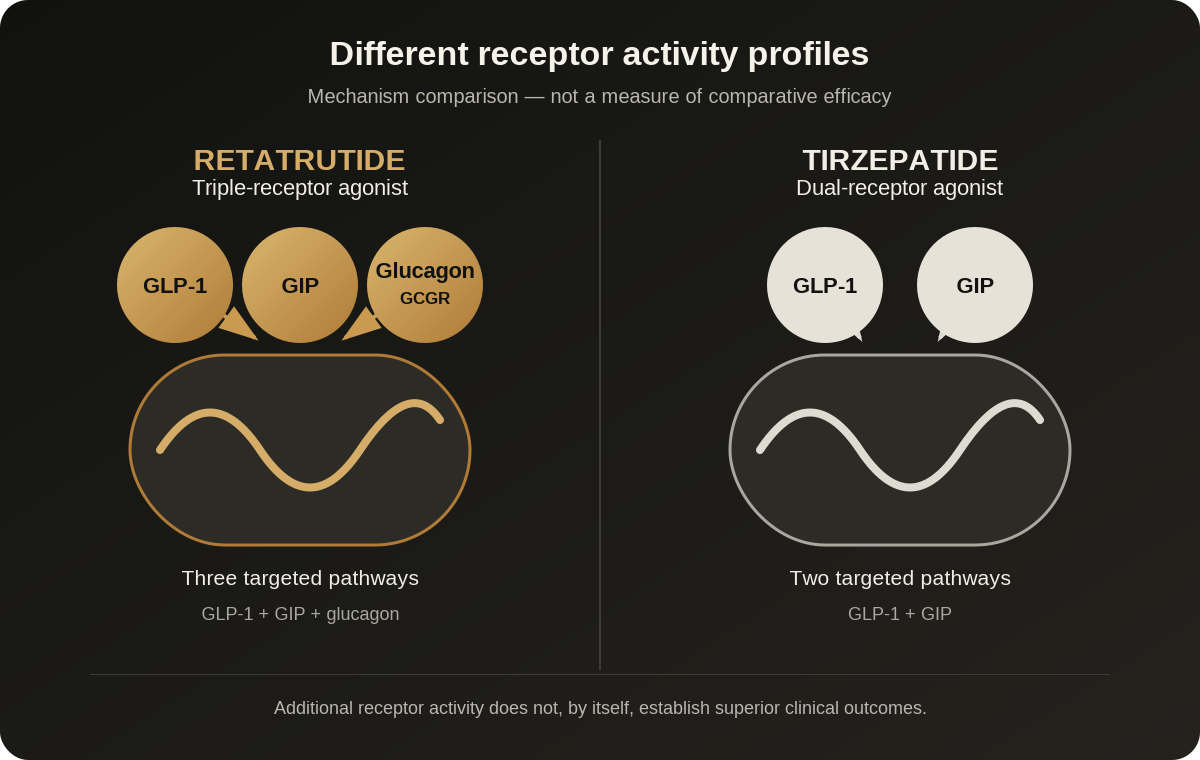
Why Does Glucagon Receptor Activation Matter?
Glucagon is a hormone primarily associated with regulating blood glucose and influencing energy metabolism. Its receptor is expressed in tissues involved in metabolic regulation, particularly the liver.
By activating the glucagon receptor alongside GLP-1 and GIP receptors, retatrutide introduces an additional biological mechanism that is not part of tirzepatide's receptor profile. Scientists are investigating how this combined activity influences energy expenditure, metabolic signalling and body-weight regulation.
However, additional receptor activity does not automatically mean superior clinical outcomes. The overall effects depend on the interaction of multiple biological pathways and must be demonstrated through clinical research.
4. What Does the Clinical Research Say About Retatrutide?
One of the most widely discussed studies was published in 2023 in The New England Journal of Medicine. The phase 2 clinical trial investigated retatrutide in 338 adults with obesity or overweight accompanied by at least one weight-related condition. Participants were assigned to different retatrutide treatment groups or placebo and followed for 48 weeks.

Key Findings from the Phase 2 Trial
At 24 weeks, the reported average weight changes included:
- 7.2% reduction in the 1 mg group.
- 12.9% reduction in the combined 4 mg group.
- 17.3% reduction in the combined 8 mg group.
- 17.5% reduction in the 12 mg group.
- 1.6% reduction in the placebo group.
At 48 weeks, the reported average reductions were:
- 8.7% in the 1 mg group.
- 17.1% in the combined 4 mg group.
- 22.8% in the combined 8 mg group.
- 24.2% in the 12 mg group.
- 2.1% in the placebo group.

These findings attracted significant scientific interest because of the magnitude of the observed changes. However, the trial was relatively small and lasted 48 weeks. Its results should not be interpreted as proof of long-term safety or as a direct comparison with tirzepatide.
Research reference: Jastreboff et al. (2023), Triple-Hormone-Receptor Agonist Retatrutide for Obesity — A Phase 2 Trial. DOI: 10.1056/NEJMoa2301972.
5. What Does the Clinical Research Say About Tirzepatide?
Tirzepatide has a substantial clinical evidence base, including large phase 3 studies. One particularly important investigation was the SURMOUNT-1 trial, published in The New England Journal of Medicine in 2022.
The study included 2,539 adults with obesity or overweight and at least one weight-related complication, without diabetes. Participants received different tirzepatide treatment regimens or placebo over 72 weeks.
Key Findings from SURMOUNT-1
The reported average body-weight changes at 72 weeks were:
- 15.0% reduction with the 5 mg group.
- 19.5% reduction with the 10 mg group.
- 20.9% reduction with the 15 mg group.
- 3.1% reduction with placebo.

These results demonstrated significant differences between the tirzepatide groups and placebo. The trial also reported improvements in several cardiometabolic measurements. As with all clinical studies, these results must be interpreted within the trial's specific population, methodology and treatment conditions.
Research reference: Jastreboff et al. (2022), Tirzepatide Once Weekly for the Treatment of Obesity. DOI: 10.1056/NEJMoa2206038.
6. Retatrutide vs. Tirzepatide: Comparing Clinical Trial Results
The available research offers an interesting starting point for understanding both compounds.
| Research measurement | Retatrutide | Tirzepatide |
|---|---|---|
| Major study discussed | Phase 2 | Phase 3 (SURMOUNT-1) |
| Study population | 338 participants | 2,539 participants |
| Study duration | 48 weeks | 72 weeks |
| Highest reported average weight reduction | 24.2% | 20.9% |
| Placebo reduction | 2.1% | 3.1% |
Does Retatrutide Produce Greater Weight Reduction?
The published phase 2 retatrutide trial reported a higher numerical average weight reduction at its highest studied dose than the SURMOUNT-1 tirzepatide trial. However, these figures cannot establish that retatrutide is more effective.
There are important differences between the studies:
- They were conducted at different stages of clinical development.
- Their participant populations and study designs were not identical.
- The treatment periods differed.
- The statistical methods and estimands used to analyse results may differ.
A direct head-to-head randomised clinical trial would provide more reliable evidence about comparative effectiveness. Until appropriate comparative data are available, claims that one compound is definitively superior to the other are premature.
The charts above intentionally appear in their own trial sections. Placing the highest values side by side as a league table would hide the differences in study design and encourage an unsupported conclusion.
7. What Are the Safety Considerations?
Safety is an essential part of any scientific comparison involving metabolic research compounds. Both retatrutide and tirzepatide have been associated with gastrointestinal adverse events in clinical investigations.
- Nausea.
- Diarrhoea.
- Vomiting.
- Constipation.
- Reduced appetite.
The frequency and severity of adverse events can vary between participants and study conditions.
What Did Retatrutide Studies Report?
In the phase 2 study, gastrointestinal events were among the most commonly reported adverse events. Their occurrence was generally more frequent in higher-dose groups and often associated with the treatment escalation period. The study also observed dose-dependent changes in heart rate, which require continued investigation.
What Did Tirzepatide Studies Report?
In SURMOUNT-1, gastrointestinal events were also among the most frequently reported adverse effects. Most were mild to moderate, although some participants discontinued treatment because of adverse events.
These findings highlight why safety assessments must consider more than average weight reduction. They should also examine tolerability, longer-term outcomes, cardiovascular measurements and individual risk factors.
Important: Clinical trial findings do not establish that an investigational compound is safe for general use. Neither experimental products nor unapproved formulations should be treated as substitutes for registered prescription medicines.
8. What Is the Regulatory Status in Canada?
For Canadian readers, the distinction between an approved medicine and an investigational compound is particularly important.
Tirzepatide in Canada
Mounjaro, containing tirzepatide, is authorized by Health Canada and listed in the Drug Product Database. Its authorized indications, including type 2 diabetes, are set out in the Canadian product monograph. Its use is subject to the approved product information and appropriate medical supervision.
Retatrutide in Canada
As of November 2026, retatrutide remains an investigational compound and is not authorized by Health Canada as a registered medicine. It is being evaluated through clinical trials, and its long-term safety and effectiveness continue to be investigated.
Internationally, Australia's TGA issued safety advisories in 2026 concerning products marketed as retatrutide outside authorised clinical research. A September 2026 advisory reported laboratory testing of a product labelled as retatrutide that instead contained undeclared semaglutide and no detectable retatrutide.
A further Australian TGA advisory published on 5 November 2026 reported inaccurate ingredient content in several unapproved peptide products. Tested products labelled as Retatrutide 10 mg contained less retatrutide than stated on the label, with significant variation between samples.
These findings highlight significant concerns regarding product identity, manufacturing quality, contamination and labelling accuracy. Consumers should not use unapproved retatrutide products obtained through online vendors, social media or informal supply channels.
Independent of regulatory status, analytical evidence also matters. Learn how to read a Certificate of Analysis and why an HPLC purity percentage is not proof of identity, content or clinical safety.
9. What Can Future Research Tell Us?
The scientific interest in retatrutide extends beyond the initial obesity studies. Researchers are investigating its potential relevance to several metabolic and health-related conditions, including:
- Type 2 diabetes.
- Cardiometabolic risk factors.
- Obesity-related complications.
- Obstructive sleep apnoea.
- Knee osteoarthritis.
- Metabolic dysfunction-associated steatotic liver disease (MASLD).
These investigations may help scientists better understand how triple-receptor activation influences different metabolic systems. Future research will also need to address questions about long-term safety, treatment durability, cardiovascular outcomes and the effects of treatment discontinuation.
Tirzepatide, meanwhile, continues to have an established clinical evidence base and ongoing research into additional therapeutic outcomes. The next stage of scientific progress will depend on larger studies, longer observation periods and reliable comparisons between treatment approaches.
10. Retatrutide vs. Tirzepatide: What Do We Know So Far?
Both compounds are important examples of advances in incretin-based metabolic research. Tirzepatide has demonstrated clinical effectiveness in large phase 3 trials and is an approved prescription medicine in Canada. Retatrutide introduces an additional glucagon receptor pathway and has demonstrated promising findings in phase 2 research, with further clinical evaluation needed.
The central scientific distinction is their receptor activity: tirzepatide activates GLP-1 and GIP receptors, while retatrutide activates GLP-1, GIP and glucagon receptors.
Although early findings have generated interest in retatrutide, numerical comparisons between separate clinical trials cannot establish superiority. The most meaningful conclusions will come from further clinical evidence and regulatory assessment.
Final Thoughts
The comparison between retatrutide and tirzepatide illustrates how metabolic research continues to evolve. Understanding their molecular mechanisms, clinical findings, limitations and regulatory status is essential to interpreting the scientific discussion responsibly.
At HelixForge Research, our objective is to explore peptide research through evidence-based scientific education, focusing on published findings rather than unsupported claims or marketing speculation. Scientific knowledge develops through evidence, critical evaluation and continued research.
Editorial disclaimer: This article is intended for scientific and educational purposes only. It does not constitute medical advice, diagnosis or treatment recommendations. Clinical trial findings are not guarantees of individual outcomes. Readers should consult appropriately qualified healthcare professionals regarding medical questions.
Frequently asked questions
What is the main difference between Retatrutide and Tirzepatide?
Tirzepatide activates GLP-1 and GIP receptors, whereas retatrutide activates GLP-1, GIP and glucagon receptors. This makes retatrutide a triple-receptor agonist and tirzepatide a dual-receptor agonist.
Is Retatrutide more effective than Tirzepatide?
A phase 2 retatrutide trial reported an average weight reduction of up to 24.2% at 48 weeks. SURMOUNT-1 reported up to 20.9% with tirzepatide at 72 weeks. However, these were separate studies, and their results do not establish that retatrutide is superior.
Is Retatrutide approved in Canada?
No. As of November 2026, retatrutide is not authorized by Health Canada. It remains an investigational compound.
Is Tirzepatide approved in Canada?
Yes. Mounjaro, which contains tirzepatide, is registered with the TGA for approved indications including chronic weight management in eligible adults and type 2 diabetes.
How many receptors does Retatrutide activate?
Retatrutide activates three receptors: GLP-1, GIP and glucagon receptors.
What were the major findings of the Retatrutide phase 2 trial?
The 2023 phase 2 study reported average body-weight reductions of up to 24.2% at 48 weeks in the highest-dose group. Gastrointestinal adverse events were among the most frequently reported effects.
What were the findings of the SURMOUNT-1 Tirzepatide trial?
The 72-week study reported average body-weight reductions of 15.0%, 19.5% and 20.9% across the three tirzepatide treatment groups, compared with 3.1% in the placebo group.
Are Retatrutide and Tirzepatide the same type of peptide?
Both are peptide-based molecules that target incretin-related pathways. However, their receptor activity differs, particularly because retatrutide also activates the glucagon receptor.
Are Retatrutide and Tirzepatide approved for research use in Canada?
Their regulatory status must be distinguished carefully. Tirzepatide is an approved prescription medicine for specific indications. Retatrutide remains investigational and is not an approved medicine for general use in Canada. Clinical research involving investigational medicines must follow applicable ethics and regulatory requirements.
Where can readers find reliable Retatrutide and Tirzepatide research?
Useful scientific resources include PubMed, The New England Journal of Medicine, ClinicalTrials.gov, Health Canada's Clinical Trials Database and the Drug Product Database.
References
- Triple-Hormone-Receptor Agonist Retatrutide for Obesity — A Phase 2 Trial, Jastreboff et al., New England Journal of Medicine, 2023
- Tirzepatide Once Weekly for the Treatment of Obesity, Jastreboff et al., New England Journal of Medicine, 2022
- Mounjaro registration and product information, Australian Therapeutic Goods Administration
- New diabetes and weight loss medicines, Australian Therapeutic Goods Administration, 2025
- TGA tests counterfeit retatrutide product following serious adverse event report, Australian Therapeutic Goods Administration, September 2026
- TGA testing finds unapproved peptides do not contain what their labels claim, Australian Therapeutic Goods Administration, November 2026
Research Disclaimer. HelixForge Research content is for educational and informational purposes only. It is not medical advice and does not describe the safety or effectiveness of any product for human use. All HelixForge products are for research use only. See our scientific disclaimer and editorial policy.
Related research

Peptide Science
How Do Peptides Work at a Scientific Level?
How peptides interact with receptors, enzymes and cells at the molecular level — from binding and signalling to breakdown — and why structure decides everything.

Peptide Science
What Are Peptides? A Complete Guide to Understanding Peptides, Their Structure, Functions and Research
Learn what peptides are, how amino acids form peptide bonds, how peptides work, and how researchers assess identity, purity and laboratory documentation.

Research Documentation
How to Read a Certificate of Analysis (CoA)
A section-by-section walkthrough of the document that records a batch's test results.
Contact the HelixForge Team
Let's Talk Science.
Have a question about an article or a topic you'd like us to explore? Say Hi to the HelixForge Team.
Stay Updated on Research
Receive research insights, scientific updates, and educational resources from HelixForge Research.