
Retatrutide vs. GLP-1 Agonists: What Makes Its Mechanism Different?

By Shaun · Published November 19, 2026 · 11 min read
Listen to this article
Device narration · estimated timeline
Device narration · voice quality depends on your browser and installed voices.

Quick Answer
Conventional selective GLP-1 receptor agonists target GLP-1. Retatrutide is an investigational triple agonist designed to activate GLP-1, GIP and glucagon receptors together. The additional targets introduce incretin and hepatic energy-metabolism signalling, but more receptor targets do not automatically establish greater safety or effectiveness. As of November 2026, retatrutide is not authorized by Health Canada.
Key Takeaways
- Semaglutide targets GLP-1; tirzepatide targets GIP and GLP-1; retatrutide targets all three including glucagon.
- Glucagon receptor activity is the distinctive addition beyond dual incretin agonism.
- Hormonal pathways interact; they are not independent or interchangeable switches.
- TRIUMPH-1 trial figures depend on the statistical estimand used.
- Unapproved products are not equivalent to clinical-trial medicines; retatrutide remains investigational in Canada.
Introduction: A Different Approach to Metabolic Research
Metabolic research has increasingly focused on hormones that regulate appetite, glucose metabolism, energy balance and body weight. Among the most extensively studied pathways are those involving glucagon-like peptide-1 (GLP-1), glucose-dependent insulinotropic polypeptide (GIP) and glucagon.
Traditional GLP-1 receptor agonists have helped researchers better understand how targeting a single hormonal pathway can influence metabolic regulation. However, newer research is exploring whether activating multiple hormone receptors simultaneously could produce different biological effects.
This is where retatrutide enters the discussion.
Retatrutide is an investigational peptide designed to activate three distinct hormone receptors: GLP-1, GIP and glucagon. Unlike conventional GLP-1 receptor agonists, which primarily target one receptor, retatrutide uses a triple-agonist approach.
But what does this actually mean? How do these three pathways work together, and why is this approach attracting attention in metabolic research?
For background, read What Is Retatrutide (RETA)? and how peptides work at a scientific level.
This article examines the scientific differences between retatrutide and traditional GLP-1 receptor agonists, focusing on their mechanisms of action, receptor activity and potential research implications.
1. Understanding GLP-1 Receptor Agonists
GLP-1 stands for glucagon-like peptide-1, a naturally occurring incretin hormone released primarily by intestinal cells after food consumption.
Its primary role is to help regulate blood glucose levels and communicate satiety signals between the digestive system and the brain.
GLP-1 receptor agonists are compounds designed to activate the GLP-1 receptor, reproducing or extending certain effects of the naturally occurring hormone.
Examples include:
- Semaglutide: A selective GLP-1 receptor agonist studied for its effects on glucose regulation, appetite and body weight.
- Liraglutide: Another GLP-1 receptor agonist with established research and clinical applications in metabolic health.
- Dulaglutide: A GLP-1 receptor agonist primarily investigated and used in the management of type 2 diabetes.
How does GLP-1 receptor activation work?
GLP-1 receptor activation influences several physiological processes:
- Insulin secretion: Stimulates insulin release in a glucose-dependent manner.
- Glucagon regulation: Reduces inappropriate glucagon secretion when blood glucose is elevated.
- Gastric emptying: Can slow the movement of food from the stomach into the small intestine.
- Appetite regulation: Influences brain pathways associated with hunger, satiety and food intake.
- Blood glucose management: Helps regulate post-meal glucose fluctuations.
These interconnected effects explain why GLP-1 receptor agonists have become an important area of metabolic and endocrinological research.
However, conventional GLP-1 receptor agonists primarily concentrate their activity on one receptor pathway.
Retatrutide introduces a broader approach.
2. What Is Retatrutide?
Retatrutide (LY3437943) is an investigational synthetic peptide developed to activate three different metabolic hormone receptors.
It is commonly described as a triple hormone receptor agonist because it targets:
- GLP-1 receptors
- GIP receptors
- Glucagon receptors
Rather than concentrating on GLP-1 signalling alone, retatrutide combines three complementary hormonal pathways within a single molecular structure.
This is particularly interesting because these hormones influence different aspects of metabolic regulation.
The scientific concept is that coordinated activation of these receptors may influence appetite, glucose metabolism, energy expenditure and body-weight regulation through multiple biological mechanisms.
The important distinction is that retatrutide does not simply activate three versions of the same biological pathway. It combines different signalling systems that may complement one another.
One, two, or three receptor targets
Retatrutide · 3 receptor targets
- GLP-1
Receptor target
- GIP
Receptor target
- Glucagon
Receptor target
Investigational triple agonist. Glucagon adds hepatic and energy-metabolism signalling beyond the two incretin targets.
Target count is not receptor potency, a treatment recommendation, or a ranking of safety and effectiveness.
3. The Main Difference: Single-Receptor vs Triple-Receptor Activation
The most significant difference between retatrutide and conventional GLP-1 agonists is the number of hormonal receptors targeted.
A conventional GLP-1 receptor agonist primarily activates GLP-1 receptors.
Retatrutide is designed to activate GLP-1, GIP and glucagon receptors simultaneously.
Mechanism comparison
| Feature | Conventional GLP-1 agonists | Retatrutide |
|---|---|---|
| GLP-1 receptor | Yes | Yes |
| GIP receptor | No | Yes |
| Glucagon receptor | No | Yes |
| Appetite signalling | Yes | Yes |
| Glucose-dependent insulin secretion | Yes | Yes, through incretin pathways |
| Glucagon receptor activation | No | Yes |
| Multiple hormonal pathways | Primarily one | Three |
| Research classification | Single agonist | Triple agonist |
An important distinction: tirzepatide is already a dual GIP/GLP-1 receptor agonist. Therefore, not all newer incretin-based compounds are single-receptor treatments.
Retatrutide extends this multi-receptor concept by adding glucagon receptor activity.
4. Why Does Retatrutide Target Three Different Hormone Receptors?
To understand the scientific interest behind retatrutide, it is useful to examine what each receptor contributes.
A. GLP-1: Appetite and satiety signalling
The GLP-1 pathway is associated with appetite regulation and glucose homeostasis.
When GLP-1 receptors are activated, several effects may occur:
- Increased glucose-dependent insulin secretion.
- Reduced inappropriate glucagon secretion.
- Delayed gastric emptying.
- Increased satiety signalling.
- Changes in food intake regulation.
This pathway is central to the metabolic research surrounding established GLP-1 medicines.
B. GIP: Additional incretin activity
GIP stands for glucose-dependent insulinotropic polypeptide.
Like GLP-1, GIP is an incretin hormone released following nutrient consumption.
Its primary recognised function involves stimulating insulin secretion in response to elevated blood glucose.
However, GIP signalling also involves other metabolic processes, including interactions with adipose tissue.
Researchers are interested in how simultaneous GLP-1 and GIP receptor activation may produce effects that differ from GLP-1 activation alone.
This is the principle behind dual agonists such as tirzepatide and forms an important part of retatrutide's molecular design.
C. Glucagon: The energy metabolism connection
The glucagon pathway introduces another dimension.
Glucagon is a hormone primarily produced by pancreatic alpha cells. It plays an important role in maintaining blood glucose levels, particularly during fasting.
Its receptor activation can:
- Stimulate hepatic glucose production.
- Influence liver glycogen breakdown.
- Affect lipid and energy metabolism.
- Participate in pathways associated with energy expenditure.
This creates an interesting research question.
Could glucagon receptor activation complement GLP-1 and GIP activity by influencing energy metabolism through mechanisms beyond appetite regulation?
Retatrutide was designed around this hypothesis.
However, glucagon receptor activation is not automatically beneficial in every context. Its effects depend on dose, physiological conditions and the interaction between the three receptor pathways.
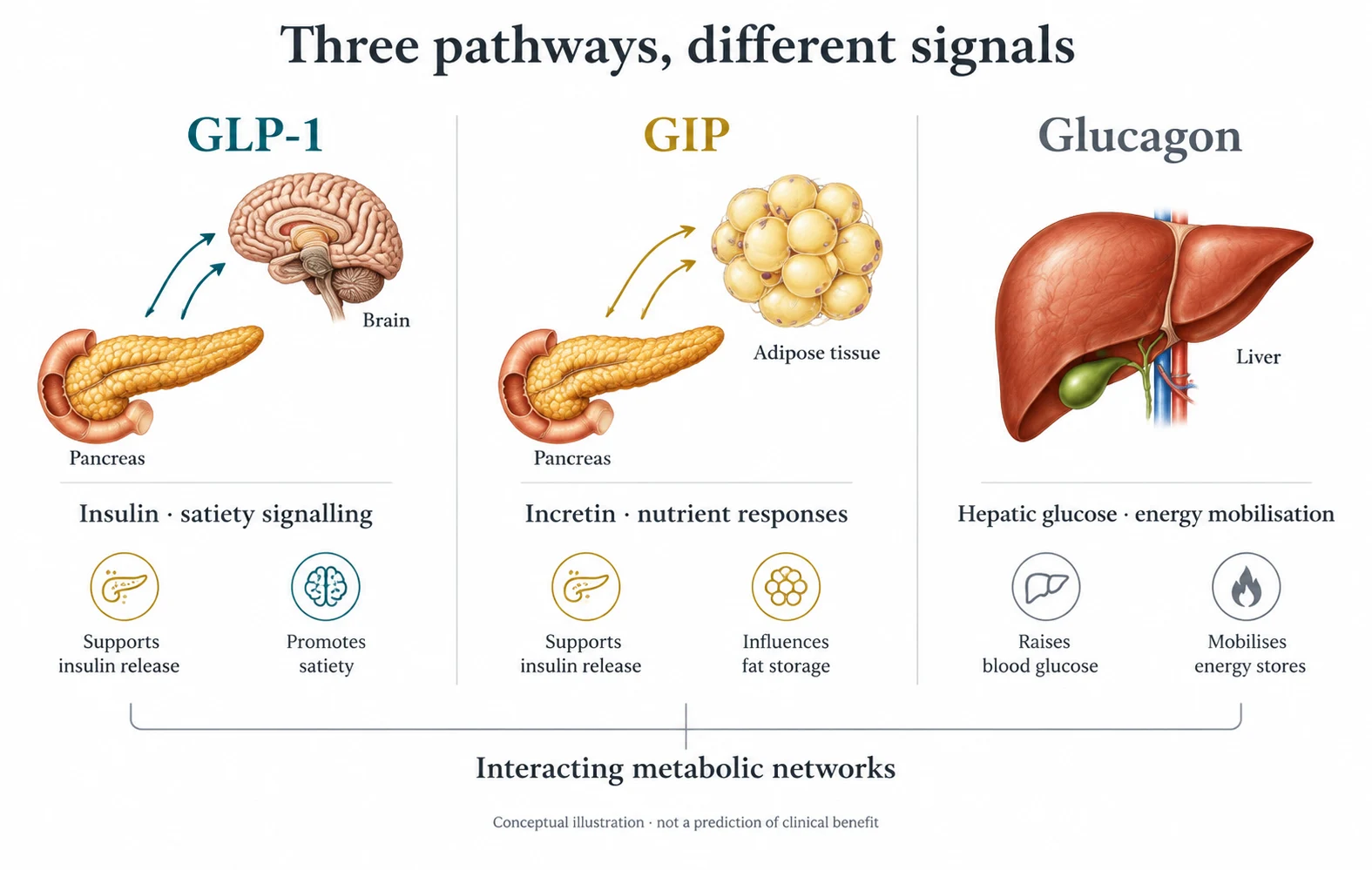
5. How the Three Pathways Work Together
The scientific interest in retatrutide comes from the potential interaction between three complementary signalling pathways.
The three pathways are not independent switches with completely separate outcomes. They interact through complex endocrine and metabolic networks.
The objective of triple-agonist research is to understand whether combining these signals can produce a broader metabolic response than targeting one receptor alone.
This is what makes retatrutide scientifically distinctive.
6. What Does Clinical Research Tell Us So Far?
Retatrutide has progressed beyond early laboratory investigation and has been evaluated in large human clinical trials.
One of the most important research programmes is the TRIUMPH clinical trial programme, which investigates retatrutide in people with obesity and related metabolic conditions.
Findings from the TRIUMPH-1 trial
In May 2026, Eli Lilly announced positive Phase 3 results from TRIUMPH-1.
The company reported that participants receiving the highest studied dose achieved an average weight reduction of approximately 28.3% over 80 weeks.
These findings attracted considerable attention because they suggested that simultaneous activation of GLP-1, GIP and glucagon receptors could have substantial effects on body-weight regulation.
The subsequent peer-reviewed publication of TRIUMPH-1 in the New England Journal of Medicine in September 2026 further advanced the clinical evidence base.
Other Phase 3 studies have also investigated retatrutide in populations with type 2 diabetes, cardiovascular disease, knee osteoarthritis and obstructive sleep apnoea.
It is important to interpret these findings carefully.
A high percentage of average weight reduction in one clinical trial does not automatically establish superiority over every GLP-1 medicine. Meaningful comparisons require appropriately designed head-to-head studies, consistent endpoints and consideration of participant characteristics.
The peer-reviewed September 2026 TRIUMPH-1 paper reported a −25.0% mean body-weight change for the highest-dose group versus −3.9% with placebo using the treatment-regimen estimand. Lilly’s earlier −28.3% headline used an efficacy estimand. Different handling of treatment discontinuation and other intercurrent events means these estimates answer different questions; they should not be treated as interchangeable.
The chart below uses the journal’s treatment-regimen analysis, not the company headline. These are group averages from one placebo-controlled trial, not a direct comparison with semaglutide or tirzepatide.
What about type 2 diabetes research?
The TRANSCEND-T2D-1 Phase 3 study, published in The Lancet in June 2026, examined retatrutide in adults with type 2 diabetes whose blood glucose was not adequately controlled through diet and exercise alone.
The research evaluated changes in HbA1c, body weight and treatment safety.
This provides another important research direction: understanding how triple-receptor activation may influence glucose regulation alongside body-weight changes.
TRIUMPH-1 · 80-week body-weight change
Treatment-regimen estimand · adults with obesity without diabetes
7. Retatrutide vs Semaglutide vs Tirzepatide
One of the most common questions in metabolic research is how retatrutide differs from established incretin-based compounds.
The comparison becomes clearer when we look at their receptor activity.
| Compound | GLP-1 | GIP | Glucagon |
|---|---|---|---|
| Semaglutide | Yes | No | No |
| Tirzepatide | Yes | Yes | No |
| Retatrutide | Yes | Yes | Yes |
Semaglutide: Single-pathway receptor activation
Semaglutide is a selective GLP-1 receptor agonist.
Its research and clinical applications have established the importance of GLP-1 signalling in appetite regulation and glucose metabolism.
Tirzepatide: Dual-pathway receptor activation
Tirzepatide activates both GIP and GLP-1 receptors.
Its dual-agonist design introduced another dimension to incretin-based metabolic research, combining two hormone pathways within one molecule.
Retatrutide: Triple-pathway receptor activation
Retatrutide takes this concept further by adding glucagon receptor activity.
Its three-receptor design is intended to combine incretin-related effects with additional metabolic signalling associated with glucagon.
The key distinction: Semaglutide targets one receptor, tirzepatide targets two, and retatrutide targets three.
This difference describes their molecular mechanisms, not a ranking of safety, suitability or effectiveness.
8. Why Is Glucagon Receptor Activation So Interesting?
The addition of glucagon receptor activity is arguably the most distinctive feature of retatrutide.
Traditionally, glucagon is recognised for its role in raising blood glucose during fasting.
When glucagon binds to its receptor in the liver, it stimulates processes that increase circulating glucose.
This might initially appear counterproductive in a compound being investigated for metabolic regulation.
However, glucagon has additional biological functions.
Researchers are investigating its relationship with:
- Hepatic energy metabolism.
- Fatty acid oxidation.
- Substrate utilisation.
- Energy expenditure.
- Liver metabolic signalling.
The research hypothesis is that combining glucagon receptor activity with GLP-1 and GIP receptor activation may help balance different metabolic effects.
For example, GLP-1 and GIP signalling can support glucose-dependent insulin secretion, while glucagon receptor activity introduces additional metabolic effects.
This interaction is central to the scientific rationale behind triple-agonist development.
It is also why retatrutide should not simply be described as another GLP-1 peptide.
9. Potential Research Areas and Scientific Applications
Retatrutide's mechanism has opened several areas of investigation.
Appetite and energy balance
Researchers are investigating how simultaneous incretin receptor activation affects satiety signalling, food intake and body-weight regulation.
Liver and metabolic function
Glucagon receptor activity provides an additional pathway for investigating hepatic glucose production, lipid metabolism and energy utilisation.
Glucose homeostasis
The interaction between GLP-1, GIP and glucagon signalling is an important area of research into insulin secretion and blood glucose regulation.
Adipose tissue and energy metabolism
Researchers are examining how hormonal signalling influences fat tissue, lipid handling and overall metabolic activity.
These research areas are interconnected. Understanding the combined effects of three hormone receptors may provide valuable insights into the complexity of human metabolism.
10. Safety, Limitations and Regulatory Status in Canada
An important distinction must be made between promising clinical research and an approved medical treatment.
As of November 2026, retatrutide has not been authorized by Health Canada.
It remains an investigational compound undergoing clinical development.
The TGA issued a safety warning on 14 September 2026 after laboratory testing of an unapproved product labelled as retatrutide found that it contained undeclared semaglutide instead, at approximately eight times the amount found in TGA-assessed semaglutide products.
Health authorities in other countries, including Australia, have also reported serious adverse events associated with unapproved products marketed under the retatrutide name.
This highlights several important research and public-health considerations:
- Product identity and authenticity cannot be assumed.
- Unapproved products have not undergone the same regulatory quality assessment as registered medicines.
- Contamination and incorrect ingredient concentrations can create serious risks.
- Clinical trial findings should not be interpreted as evidence that unregulated products are safe.
The distinction between a research compound and a legally approved medicine is particularly important in Canada.
Anyone considering a treatment affecting metabolic or hormonal pathways should seek advice from a qualified healthcare professional.
11. What Makes Retatrutide Different? The Scientific Summary
Retatrutide represents a different approach to metabolic research because it combines three hormone receptor pathways within one investigational peptide.
Its distinction is not simply the number of receptors it activates, but the biological processes those receptors influence.
| Research dimension | GLP-1 agonists | Retatrutide |
|---|---|---|
| Primary receptor strategy | GLP-1 | GLP-1, GIP and glucagon |
| Incretin signalling | Yes | Yes |
| Additional GIP signalling | Generally absent | Present |
| Glucagon receptor signalling | Absent | Present |
| Metabolic research scope | Predominantly GLP-1 pathways | Multiple interacting pathways |
The central scientific question is whether coordinated activation of these three receptors can produce metabolic effects that go beyond those achieved through conventional single-receptor or dual-receptor approaches.
That question continues to drive clinical investigation.
Conclusion: Moving Beyond Single-Hormone Metabolic Research
The development of retatrutide represents an important evolution in the scientific investigation of metabolic hormone signalling.
While conventional GLP-1 receptor agonists focus primarily on one hormonal pathway, retatrutide introduces a coordinated approach involving GLP-1, GIP and glucagon receptors.
This combination provides researchers with an opportunity to investigate how appetite regulation, insulin secretion, glucose homeostasis and energy metabolism interact within a single biological system.
Its clinical development has generated considerable interest, particularly following positive Phase 3 findings in obesity and type 2 diabetes research.
Nevertheless, further evidence and regulatory assessment remain essential.
For researchers interested in understanding the next generation of metabolic peptides, retatrutide offers an interesting example of how multi-receptor pharmacology is expanding the boundaries of metabolic science.
At HelixForge Research, we believe understanding the mechanisms behind emerging research compounds is just as important as understanding the molecules themselves.
Explore more scientific insights and educational resources at HelixForge Research.
Frequently asked questions
Frequently Asked Questions (FAQs)
1. What is the main difference between retatrutide and GLP-1 agonists? The main difference is receptor activity. Conventional GLP-1 agonists primarily activate GLP-1 receptors, whereas retatrutide activates GLP-1, GIP and glucagon receptors simultaneously.
Is retatrutide a GLP-1 peptide?
Retatrutide includes GLP-1 receptor activity, but it is more accurately classified as a triple hormone receptor agonist because it also activates GIP and glucagon receptors.
Is retatrutide different from semaglutide?
Yes. Semaglutide selectively activates GLP-1 receptors, while retatrutide is designed to activate three different metabolic hormone receptors.
Is retatrutide different from tirzepatide?
Yes. Tirzepatide activates GIP and GLP-1 receptors. Retatrutide adds glucagon receptor activity, making it a triple agonist rather than a dual agonist.
Why does retatrutide activate glucagon receptors?
Glucagon receptor activation influences hepatic glucose production and other metabolic processes, including pathways associated with energy expenditure and substrate utilisation. Researchers are investigating how these effects interact with GLP-1 and GIP signalling.
Is retatrutide approved in Canada?
No. As of November 2026, retatrutide has not received TGA approval. It remains an investigational compound, and unapproved products marketed under its name should not be considered equivalent to a clinically tested pharmaceutical product.
Is retatrutide more effective than semaglutide?
Clinical trials have reported substantial effects on body weight with retatrutide. However, results from separate trials cannot establish direct superiority. Proper head-to-head clinical comparisons are necessary.
What is the triple agonist mechanism?
A triple agonist activates three receptor systems. In retatrutide's case, these are GLP-1, GIP and glucagon receptors. Each contributes different biological signals associated with appetite, glucose regulation and energy metabolism.
Is retatrutide the same as a GLP-1 and GIP dual agonist?
No. A dual agonist targets two receptors, while retatrutide targets three. The addition of glucagon receptor activation is the defining feature of its molecular design.
References
- Retatrutide, a Triple Hormone Receptor Agonist, for Treatment of Obesity, New England Journal of Medicine (2026)
- TRIUMPH-1 Phase 3 results announcement (21 May 2026), Eli Lilly and Company
- TRANSCEND-T2D-1: efficacy and safety of retatrutide in type 2 diabetes, The Lancet (2026)
- TGA tests counterfeit retatrutide product following serious adverse event report, Therapeutic Goods Administration (14 September 2026)
- Toxicity linked to unapproved peptide product labelled Retatrutide, Victorian Department of Health (19 June 2026)
Research Disclaimer. HelixForge Research content is for educational and informational purposes only. It is not medical advice and does not describe the safety or effectiveness of any product for human use. All HelixForge products are for research use only. See our scientific disclaimer and editorial policy.
Related research

Peptide Research & Scientific Comparisons
What Is Retatrutide (RETA)? Understanding the Triple Agonist Approach
A gentle, evidence-led guide to retatrutide: how it targets GLP-1, GIP and glucagon receptors, where Phase 3 research stands, how it differs from tirzepatide and its Canadian status.

Peptide Research & Scientific Comparisons
Retatrutide vs. Tirzepatide: What Does the Research Say?
Explore Retatrutide vs. Tirzepatide, comparing GLP-1, GIP and glucagon pathways, clinical trial results, potential benefits and safety.

Peptide Science
How Do Peptides Work at a Scientific Level?
How peptides interact with receptors, enzymes and cells at the molecular level — from binding and signalling to breakdown — and why structure decides everything.
Contact the HelixForge Team
Let's Talk Science.
Have a question about an article or a topic you'd like us to explore? Say Hi to the HelixForge Team.
Stay Updated on Research
Receive research insights, scientific updates, and educational resources from HelixForge Research.