
KPV vs. BPC-157: Understanding Their Different Research Pathways

By Shaun · Published November 17, 2026 · 11 min read
Listen to this article
Device narration · estimated timeline
Device narration · voice quality depends on your browser and installed voices.
Quick Answer
KPV is a three-amino-acid sequence associated with α-MSH, studied mainly in inflammatory and intestinal signalling. BPC-157 is a synthetic 15-amino-acid peptide studied in tissue and vascular biology. Their research overlaps, but neither the length difference nor preclinical findings establish comparative human safety or effectiveness.
Key Takeaways
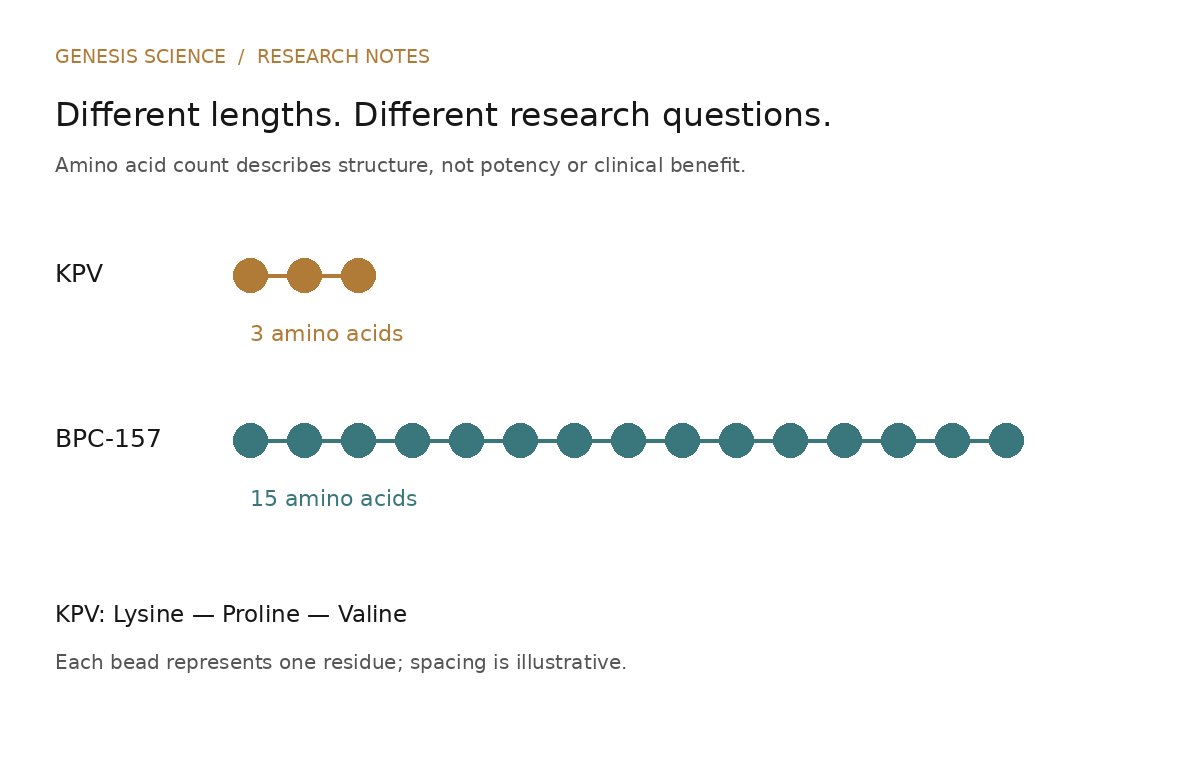
- KPV contains 3 amino acids; BPC-157 contains 15.
- KPV research often focuses on NF-κB, cytokines and intestinal epithelial responses.
- BPC-157 research includes vascular signalling and experimental tissue models.
- Most evidence is preclinical; direct comparative human evidence is insufficient.
- Research labels and scientific publications are not regulatory approval.
KPV and BPC-157 often appear in the same conversation, but they tell rather different scientific stories. Both are peptides under investigation; their structures, origins and the questions researchers ask about them are not the same.
A little background helps. Explore what peptides are and how peptide signalling works before comparing the evidence.
KPV is a naturally occurring tripeptide sequence associated with alpha-melanocyte-stimulating hormone (α-MSH). It has been investigated primarily for its potential interactions with inflammatory signalling pathways, intestinal biology and immune-related cellular responses.
BPC-157, on the other hand, is a synthetic pentadecapeptide derived from a sequence associated with a protective protein found in gastric juice. Research has explored its relationship with tissue repair, gastrointestinal biology, vascular signalling and experimental models of musculoskeletal injury.
So, what separates KPV from BPC-157? How do their proposed biological mechanisms differ, and what does the available scientific literature actually tell us?
This article examines both peptides from a molecular and research perspective, highlighting their different experimental pathways, scientific findings and limitations.
What Is KPV?
KPV is a tripeptide consisting of three amino acids:
- Lysine (K)
- Proline (P)
- Valine (V)
Its three-letter designation comes directly from the standard single-letter abbreviations of these amino acids.
KPV corresponds to the C-terminal sequence of alpha-melanocyte-stimulating hormone (α-MSH), a peptide belonging to the melanocortin family.
α-MSH is involved in several biological processes, including pigmentation, immune regulation and inflammatory signalling.
Researchers became interested in KPV because experimental studies suggest that this short peptide sequence may retain certain biological activities associated with the larger α-MSH molecule.
Unlike α-MSH, KPV does not have the same complete molecular structure. Its smaller size makes it an interesting subject for investigating peptide-specific interactions and inflammatory signalling.
Key Molecular Characteristics of KPV
| Characteristic | Description |
|---|---|
| Full name | Lysine-Proline-Valine |
| Amino acid sequence | Lys-Pro-Val |
| Peptide length | 3 amino acids |
| Classification | Tripeptide |
| Biological relationship | C-terminal sequence of α-MSH |
| Primary research interest | Inflammatory signalling |
| Additional research areas | Intestinal biology and immune-related cellular responses |
KPV and Inflammatory Signalling Research
One of the major areas of KPV research involves its relationship with inflammatory signalling.
Inflammation is a complex biological response involving immune cells, signalling molecules, cytokines and intracellular regulatory pathways.
Although inflammation is an essential component of normal biological defence, excessive or prolonged inflammatory signalling can contribute to tissue dysfunction.
Researchers have investigated KPV because experimental findings suggest that it may influence certain inflammatory pathways.
Particular attention has been given to:
- Nuclear factor kappa B (NF-κB) signalling
- Pro-inflammatory cytokine expression
- Intestinal epithelial cell responses
- Immune-related signalling mechanisms
- Interactions between inflammatory mediators
NF-κB is an important transcription factor involved in regulating genes associated with inflammation and immune responses.
Experimental research has suggested that KPV may influence NF-κB-related signalling and the expression of certain inflammatory mediators.
However, the precise molecular mechanisms and their relevance to human physiology require further investigation.
KPV and Intestinal Research
Another important area of KPV investigation involves intestinal biology.
The intestinal epithelial barrier is a specialised cellular structure that separates the contents of the digestive tract from underlying tissues.
It plays an essential role in maintaining intestinal integrity and regulating interactions between the intestinal environment and the immune system.
Researchers have investigated KPV in experimental models involving:
- Intestinal epithelial signalling
- Inflammatory responses in intestinal tissues
- Barrier-related cellular processes
- Cytokine regulation
- Intestinal inflammatory models
These investigations have helped establish KPV as an interesting subject in gastrointestinal and inflammatory biology research.
Importantly, preclinical observations do not establish KPV as an approved treatment for inflammatory bowel disease or other gastrointestinal conditions.
What Is BPC-157?
BPC-157, also known as Body Protection Compound-157, is a synthetic peptide consisting of 15 amino acids.
It is based on a sequence associated with a protective protein identified in gastric juice.
Unlike KPV, which is a naturally occurring short peptide sequence derived from α-MSH, BPC-157 is a laboratory-synthesised peptide investigated primarily through experimental models.
Its research profile includes several biological areas, particularly those involving tissue biology, vascular processes and gastrointestinal research.
Key Molecular Characteristics of BPC-157
| Characteristic | Description |
|---|---|
| Full name | Body Protection Compound-157 |
| Peptide length | 15 amino acids |
| Classification | Pentadecapeptide |
| Molecular origin | Synthetic peptide based on a sequence associated with gastric protective protein |
| Primary research interests | Tissue repair and gastrointestinal biology |
| Additional research areas | Vascular signalling and musculoskeletal research |
| Evidence base | Predominantly preclinical |
BPC-157 and Tissue Repair Research
One of the most frequently investigated areas of BPC-157 research concerns tissue repair.
Tissue repair is a complex biological process involving several coordinated stages, including:
- Initial inflammatory responses
- Cellular migration
- Formation of new blood vessels
- Extracellular matrix remodelling
- Tissue restructuring
Researchers have explored BPC-157 in experimental models involving different tissue types.
These include studies examining:
- Tendon-related experimental injuries
- Ligament tissue models
- Muscle injury models
- Gastrointestinal tissue
- Vascular responses
- Cellular migration and repair-associated processes
An important area of interest is angiogenesis, the biological process through which new blood vessels develop from existing vascular structures.
Some experimental studies have investigated BPC-157 in relation to angiogenic signalling and endothelial cell activity.
These mechanisms are scientifically interesting because vascular development and tissue repair are closely connected biological processes.
Nevertheless, findings from animal experiments cannot establish clinical effectiveness in humans.
BPC-157 and Vascular Signalling
Blood vessels play an important role in tissue biology.
They transport oxygen, nutrients and other essential substances to different tissues while participating in numerous signalling processes.
Researchers have investigated BPC-157 in experimental systems involving vascular responses and angiogenesis.
One area of interest involves nitric oxide (NO), an important signalling molecule involved in vascular regulation.
Other investigations have examined interactions involving vascular endothelial growth factor (VEGF) and related pathways.
These studies provide possible directions for understanding the relationship between BPC-157 and vascular biology.
However, the precise mechanisms remain under investigation, and the existing experimental evidence should not be interpreted as proof of therapeutic benefit.
KPV vs. BPC-157: Key Differences Explained
Research pathways
KPV · 3 amino acids
C-terminal sequence of α-MSH
- 01Intestinal epithelial models
- 02NF-κB & cytokine signalling
- 03Inflammatory responses
How might this short sequence influence inflammatory signalling?
Simplified experimental research directions. These are not exclusive functions, proven mechanisms or a comparison of therapeutic effectiveness.
Although both peptides are investigated in experimental research, their molecular characteristics and primary research pathways are considerably different.
| Feature | KPV | BPC-157 |
|---|---|---|
| Amino acid length | 3 | 15 |
| Peptide classification | Tripeptide | Pentadecapeptide |
| Molecular relationship | C-terminal sequence of α-MSH | Synthetic peptide based on a gastric protective protein sequence |
| Main research focus | Inflammatory signalling | Tissue repair and gastrointestinal biology |
| Important pathways studied | NF-κB and cytokine signalling | Angiogenesis, vascular signalling and repair-associated processes |
| Gastrointestinal research | Intestinal inflammatory signalling | Gastric and intestinal tissue biology |
| Additional research | Immune-related cellular responses | Tendon, ligament and muscle experimental models |
| Evidence status | Primarily experimental | Predominantly preclinical |
The main difference: KPV research is more closely associated with inflammatory and immune-related signalling, whereas BPC-157 research places greater emphasis on tissue biology, vascular processes and experimental repair mechanisms.
These are broad research distinctions rather than exclusive biological functions. Both peptides have been investigated across multiple experimental systems.
Understanding Their Different Research Pathways
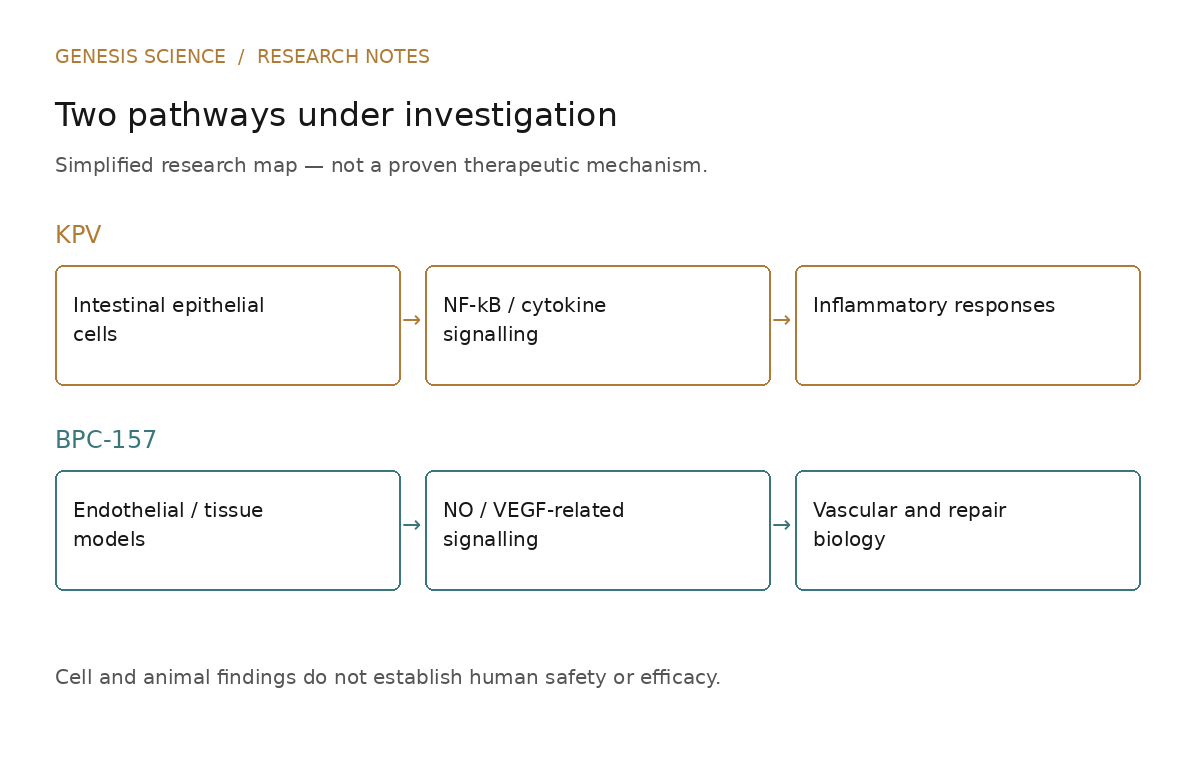
To understand why KPV and BPC-157 are studied separately, it is useful to examine their proposed molecular pathways.
1. KPV: The Inflammatory Signalling Pathway
KPV research frequently focuses on how short peptide sequences interact with inflammatory regulation.
One important area involves NF-κB.
NF-κB is a transcription factor that regulates the expression of numerous genes involved in immune and inflammatory responses.
When activated by certain cellular signals, NF-κB can influence the production of inflammatory mediators.
Experimental investigations have suggested that KPV may modulate aspects of this signalling system.
A simplified representation of the research pathway is:
KPV-related experimental signalling → NF-κB pathway investigation → Changes in inflammatory mediator expression
Researchers are also interested in how KPV interacts with intestinal epithelial cells and other components of the gastrointestinal environment.
It is important to recognise that this is a simplified representation of an experimental research area, not a fully established molecular mechanism.
2. BPC-157: Tissue and Vascular Research Pathways
BPC-157 research has explored a broader range of processes associated with tissue biology.
One prominent research area is angiogenesis.
Angiogenesis involves the development of new blood vessels, which is important in numerous physiological and tissue-repair processes.
Researchers have investigated possible interactions between BPC-157 and signalling systems associated with vascular endothelial cells.
Another area involves nitric oxide signalling, which participates in vascular regulation.
A simplified representation is:
BPC-157 experimental models → Vascular and cellular signalling investigation → Angiogenesis and tissue-repair-related processes
Additional research has explored interactions involving growth factors, cellular migration and extracellular matrix-related processes.
The exact molecular contributions of these pathways remain incompletely understood.
Comparing the Scientific Evidence for KPV and BPC-157
A fair comparison is not a contest. These peptides are mostly studied separately, and there is not enough comparative human evidence to rank their safety or effectiveness.
A useful way to understand these peptides is to distinguish between their experimental findings and established human clinical evidence.
KPV Research
KPV has been investigated in cellular and animal models involving inflammatory processes.
Research has explored its relationship with intestinal inflammation, epithelial signalling and NF-κB-associated pathways.
These studies provide useful information about the potential biological activity of the KPV sequence.
However, there is insufficient high-quality human clinical evidence to establish its safety and effectiveness for treating inflammatory or gastrointestinal diseases.
BPC-157 Research
BPC-157 has generated considerable preclinical research interest, particularly in experimental tissue-injury and gastrointestinal models.
Studies have investigated its possible interactions with angiogenesis, vascular signalling, cellular migration and tissue repair.
Although these findings have generated interest in its biological mechanisms, the evidence remains predominantly preclinical.
Robust, independently replicated human clinical trials are needed before therapeutic conclusions can be drawn.
Why the Difference in Evidence Matters
Scientific research develops through different stages.
Laboratory studies can identify molecular interactions, while animal studies can investigate biological processes within more complex systems.
Human clinical trials are necessary to evaluate safety, dosage, pharmacology and clinical outcomes in people.
A biological effect observed in a laboratory or animal model does not automatically translate into a safe or effective human application.
This distinction is particularly important when interpreting research involving emerging peptides.
KPV vs. BPC-157: Similarities and Differences in Research
Despite their different molecular structures, KPV and BPC-157 share several broader research characteristics.
Both are studied in relation to gastrointestinal biology.
Both have been investigated in experimental models involving cellular responses.
Both have attracted interest because of their potential interactions with biological signalling systems.
However, their central research questions differ.
| Research Question | KPV | BPC-157 |
|---|---|---|
| How does the peptide interact with inflammatory signalling? | Major research focus | Investigated in some experimental contexts |
| How does it relate to intestinal biology? | Inflammatory and epithelial signalling | Gastric and intestinal tissue processes |
| Is vascular signalling a major research area? | Less central | More prominent |
| Is angiogenesis investigated? | Not a defining research focus | Yes |
| Is tissue repair a major research area? | Not the primary focus | Yes |
| Are established human therapeutic applications available? | Not established | Not established |
These distinctions demonstrate why comparing peptides solely by their general research popularity can be misleading.
Their molecular characteristics and proposed biological activities need to be considered separately.
What Are the Current Limitations of KPV and BPC-157 Research?
Both peptides remain subjects of ongoing scientific investigation.
Several limitations should be considered when interpreting the available evidence.
Limited Human Clinical Evidence
Much of the available literature for both peptides involves cell-based research and animal experiments.
The number and quality of human clinical studies are insufficient to establish their therapeutic safety and effectiveness.
Incomplete Understanding of Molecular Mechanisms
Although researchers have identified several possible signalling interactions, the precise molecular mechanisms are not fully established.
Further work is needed to understand how these peptides interact with different cellular environments.
Differences Between Experimental Models
Results can vary depending on the species, tissue type, experimental conditions and research methodology.
Consequently, findings from one model should not automatically be generalised to another.
Long-Term Safety Questions
Long-term safety, pharmacokinetics, biological distribution and potential adverse effects require more comprehensive investigation.
These unanswered questions are important considerations in the scientific evaluation of emerging peptide compounds.
Canadian Regulatory Considerations for Peptide Research
For Canadian researchers, understanding the regulatory framework surrounding peptide products is essential.
Health Canada regulates drugs and health products in Canada under the Food and Drugs Act.
A peptide's regulatory status depends on factors such as its composition, intended purpose, presentation, supply and applicable legal provisions.
Importantly, a research-use-only disclaimer does not automatically exempt a peptide product from Canadian drug and health product requirements.
Researchers and organisations should verify applicable requirements before importing, manufacturing, supplying, advertising or otherwise handling peptide products.
For current official information, consult Health Canada.
Scientific publications should also be distinguished from regulatory approval. A peptide being investigated in published research does not mean it is approved for human therapeutic use.
Conclusion: Two Peptides, Different Scientific Research Directions
KPV and BPC-157 demonstrate how different peptide structures can become the focus of distinct scientific investigations.
KPV, a three-amino-acid sequence associated with α-MSH, is primarily investigated for its relationship with inflammatory signalling, NF-κB activity and intestinal biology.
BPC-157, a synthetic 15-amino-acid peptide, has attracted research interest in tissue repair, gastrointestinal biology, vascular signalling and angiogenesis.
Although both peptides have been investigated across different biological systems, their molecular characteristics and research pathways should not be treated as interchangeable.
The existing literature offers valuable insights into their experimental biology, but further research is necessary to establish their mechanisms, safety profiles and relevance to human physiology.
At HelixForge Research, understanding the science behind emerging research peptides means looking beyond headlines and focusing on molecular biology, experimental evidence and responsible scientific interpretation.
This article is intended for educational and scientific research information only. It does not constitute medical advice, recommend peptide use or establish therapeutic efficacy. Most evidence discussed is preclinical, and further human research is necessary to establish safety and clinical relevance. Canadian regulatory requirements apply according to the nature and intended use of each product.
Frequently asked questions
What is the main difference between KPV and BPC-157?
The main difference is their molecular structure and research focus. KPV is a three-amino-acid peptide primarily investigated in inflammatory signalling and intestinal biology, while BPC-157 is a 15-amino-acid synthetic peptide studied in tissue repair, vascular biology and gastrointestinal research.
Is KPV the same as BPC-157?
No. KPV and BPC-157 are chemically different peptides with different amino acid sequences, molecular characteristics and proposed biological mechanisms. They are investigated in overlapping but distinct areas of experimental research.
How many amino acids are in KPV?
KPV contains three amino acids: lysine, proline and valine. It is classified as a tripeptide and corresponds to the C-terminal sequence of alpha-melanocyte-stimulating hormone.
How many amino acids are in BPC-157?
BPC-157 contains 15 amino acids, making it a pentadecapeptide. It is a synthetic peptide based on a sequence associated with a protective protein found in gastric juice.
What biological pathway is associated with KPV research?
KPV research has particularly focused on inflammatory signalling, including NF-κB-related pathways and the regulation of inflammatory mediators. Intestinal epithelial biology is another important research area.
What biological pathways are associated with BPC-157 research?
BPC-157 has been investigated in experimental studies involving angiogenesis, vascular signalling, nitric oxide-related processes, cellular migration and tissue-repair-associated mechanisms.
Are KPV and BPC-157 both studied in gastrointestinal research?
Yes. Both have been investigated in gastrointestinal-related experimental models, although their research emphasis differs. KPV is more closely associated with intestinal inflammatory signalling, while BPC-157 has been studied in gastric and intestinal tissue biology.
Is there scientific evidence comparing KPV and BPC-157 directly?
The scientific literature primarily investigates these peptides separately. There is insufficient direct comparative human research to establish which has greater biological activity, safety or clinical effectiveness.
Are KPV and BPC-157 authorized drugs in Canada?
The regulatory status must be assessed under Canada's Food and Drugs Act. Neither peptide should be assumed to be an approved therapeutic treatment simply because scientific studies have investigated it.
Why are researchers interested in KPV and BPC-157?
Researchers are interested in KPV because of its potential interactions with inflammatory and intestinal signalling pathways. BPC-157 attracts research interest because of experimental findings involving tissue biology, vascular processes and gastrointestinal systems.
What is the difference between a preclinical study and a clinical trial?
A preclinical study generally investigates a compound using laboratory experiments or animal models. A clinical trial evaluates an intervention in human participants under a defined research protocol. Preclinical findings alone cannot establish human safety or therapeutic effectiveness.
Where can researchers find scientific publications about KPV and BPC-157?
Researchers can explore peer-reviewed publications through PubMed, Europe PMC and academic journals. Searching for the specific peptide name alongside terms such as NF-κB, intestinal inflammation, angiogenesis and tissue repair can help identify relevant research.
References
- Targeting melanocortin receptors as a novel strategy to control inflammation, Catania et al., Pharmacological Reviews, 2004
- Alpha-melanocyte-stimulating hormone and related tripeptides: Biochemistry, anti-inflammatory and protective effects in vitro and in vivo, and future perspectives, Brzoska et al., Endocrine Reviews, 2008
- BPC-157 gastrointestinal research — publication search, PubMed; discovery link, not an individually verified citation
- BPC-157 musculoskeletal research — publication search, PubMed; discovery link, not an individually verified citation
- KPV and inflammatory signalling — publication search, PubMed
- Emerging Use of BPC-157 in Orthopaedic Sports Medicine: A Systematic Review, Vasireddi et al., HSS Journal, 2025
- Drugs and health products, Health Canada
Research Disclaimer. HelixForge Research content is for educational and informational purposes only. It is not medical advice and does not describe the safety or effectiveness of any product for human use. All HelixForge products are for research use only. See our scientific disclaimer and editorial policy.
Related research
Scientific Literacy
What Is BPC-157? Research Background and Current Scientific Evidence
A measured overview of a 15-amino-acid research peptide, the preclinical literature and the limits of human evidence.
Peptide Research & Scientific Comparisons
BPC-157 vs. TB-500: Comparing the Science Behind Tissue Repair Research
BPC-157 vs. TB-500: explore their proposed mechanisms, tissue repair research, scientific evidence, safety concerns and regulatory status in Canada.

Peptide Science
What Are Peptides? A Complete Guide to Understanding Peptides, Their Structure, Functions and Research
Learn what peptides are, how amino acids form peptide bonds, how peptides work, and how researchers assess identity, purity and laboratory documentation.
Contact the HelixForge Team
Let's Talk Science.
Have a question about an article or a topic you'd like us to explore? Say Hi to the HelixForge Team.
Stay Updated on Research
Receive research insights, scientific updates, and educational resources from HelixForge Research.