
CJC-1295 vs. Ipamorelin: Understanding Their Mechanisms

By Shaun · Published November 23, 2026 · 9 min read
Listen to this article
Device narration · estimated timeline
Device narration · voice quality depends on your browser and installed voices.
Quick Answer
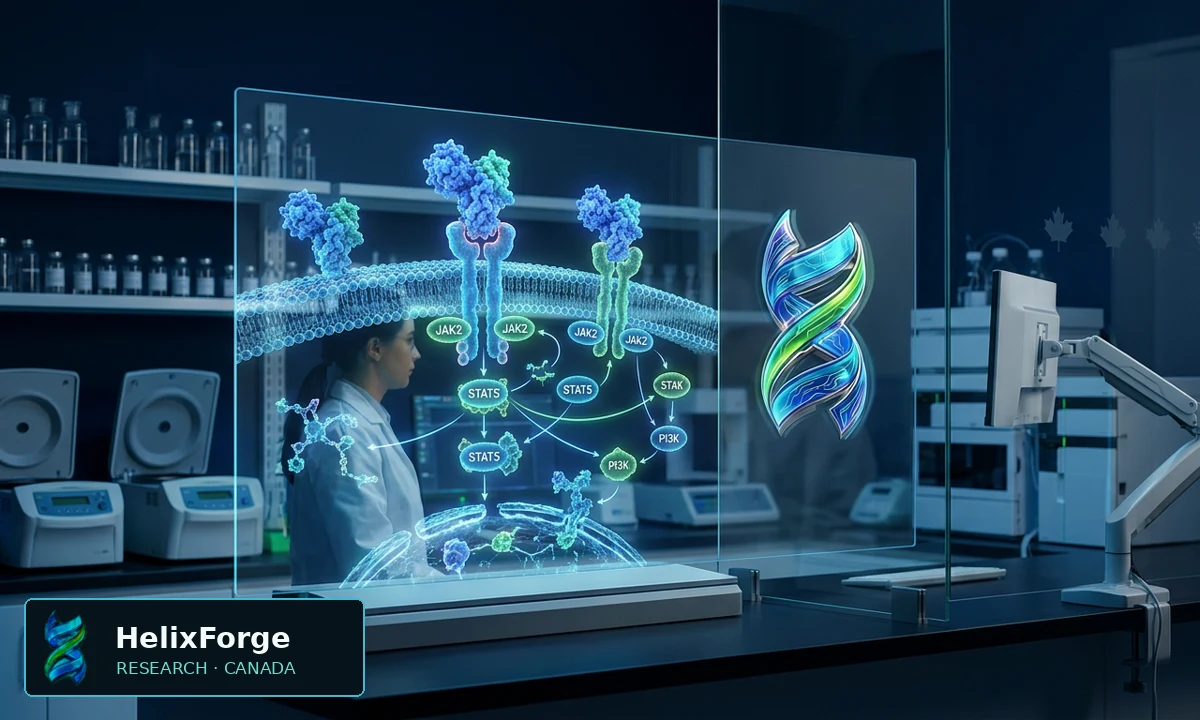
CJC-1295 interacts with the GHRH receptor and is primarily associated with Gs, cAMP and PKA signalling. Ipamorelin activates the ghrelin receptor GHS-R1a, associated with Gq/11, PLC, IP3, DAG and calcium mobilisation. Both are studied upstream of pituitary growth hormone release, but different mechanisms do not establish comparative clinical benefit or safety.
Key Takeaways
- CJC-1295: GHRH receptor → Gs → adenylyl cyclase → cAMP → PKA.
- Ipamorelin: GHS-R1a → Gq/11 → PLC → IP3/DAG → intracellular calcium signalling.
- DAC-mediated albumin binding influences persistence, not receptor identity.
- Different study models and endpoints cannot validate a combination or rank clinical effectiveness.
Introduction
The human endocrine system relies on a complex network of hormones, receptors and chemical messengers to regulate essential biological processes. One particularly interesting area of scientific investigation involves the mechanisms responsible for growth hormone (GH) secretion.
For a broader overview, read CJC-1295 vs. Ipamorelin: Understanding Their Differences. This companion guide follows the intracellular messages in more detail.
Among the synthetic peptides studied in this field, CJC-1295 and Ipamorelin stand out because they interact with two different biological signalling pathways associated with growth hormone regulation.
Although these compounds are frequently discussed together, their mechanisms of action are not the same.
CJC-1295 is a synthetic analogue of growth hormone-releasing hormone (GHRH), a naturally occurring hypothalamic hormone. Ipamorelin, on the other hand, is a selective growth hormone secretagogue that interacts with the ghrelin receptor, also known as GHS-R1a.
So, what actually happens when these receptors are activated? How do the two signalling pathways differ, and why are scientists interested in studying them?
Understanding CJC-1295 vs. Ipamorelin requires examining their molecular structures, receptor interactions and intracellular signalling processes.
This article explores the underlying science behind both compounds and explains how their different mechanisms contribute to research into endocrine regulation.
Understanding the Biological Background: How Is Growth Hormone Regulated?
Before comparing CJC-1295 and Ipamorelin, it is important to understand how the body naturally regulates growth hormone.
Growth hormone is produced and released by specialised cells called somatotrophs, located in the anterior pituitary gland.
Its secretion is controlled by several interconnected signals originating primarily from the hypothalamus.
Three important regulatory components include:
- Growth Hormone-Releasing Hormone (GHRH): Stimulates growth hormone synthesis and secretion.
- Somatostatin: Suppresses growth hormone release.
- Ghrelin: Activates signalling pathways involved in growth hormone secretion.
These signalling molecules help regulate the timing, frequency and magnitude of growth hormone release.
The process is not controlled by a single receptor or hormone. Instead, it involves multiple pathways that communicate with one another.
This is particularly relevant when examining CJC-1295 and Ipamorelin because each compound interacts with a different part of this regulatory system.
What Is the Mechanism of Action of CJC-1295?
CJC-1295 is a synthetic analogue based on the structure of human growth hormone-releasing hormone.
Its primary mechanism involves interaction with the GHRH receptor, which is expressed on growth hormone-producing somatotroph cells in the anterior pituitary gland.
1. Interaction With the GHRH Receptor
Under normal physiological conditions, GHRH is released from the hypothalamus and travels through the hypophyseal portal circulation to the anterior pituitary.
There, it binds to specific GHRH receptors on somatotroph cells.
CJC-1295 was developed to interact with this same receptor system.
The GHRH receptor belongs to the G protein-coupled receptor (GPCR) family. When activated, it initiates a series of intracellular signalling events that contribute to growth hormone synthesis and secretion.
2. Activation of the cAMP Signalling Pathway
One of the principal intracellular pathways associated with GHRH receptor activation is the cyclic adenosine monophosphate (cAMP) pathway.
The process can be simplified into several stages:
- CJC-1295 interacts with the GHRH receptor.
- The receptor activates its associated stimulatory G protein (Gs).
- Gs stimulates the enzyme adenylyl cyclase.
- Adenylyl cyclase increases intracellular cAMP production.
- cAMP activates protein kinase A (PKA).
- Downstream cellular signalling contributes to growth hormone synthesis and secretion.
This pathway is an important component of normal pituitary endocrine function.
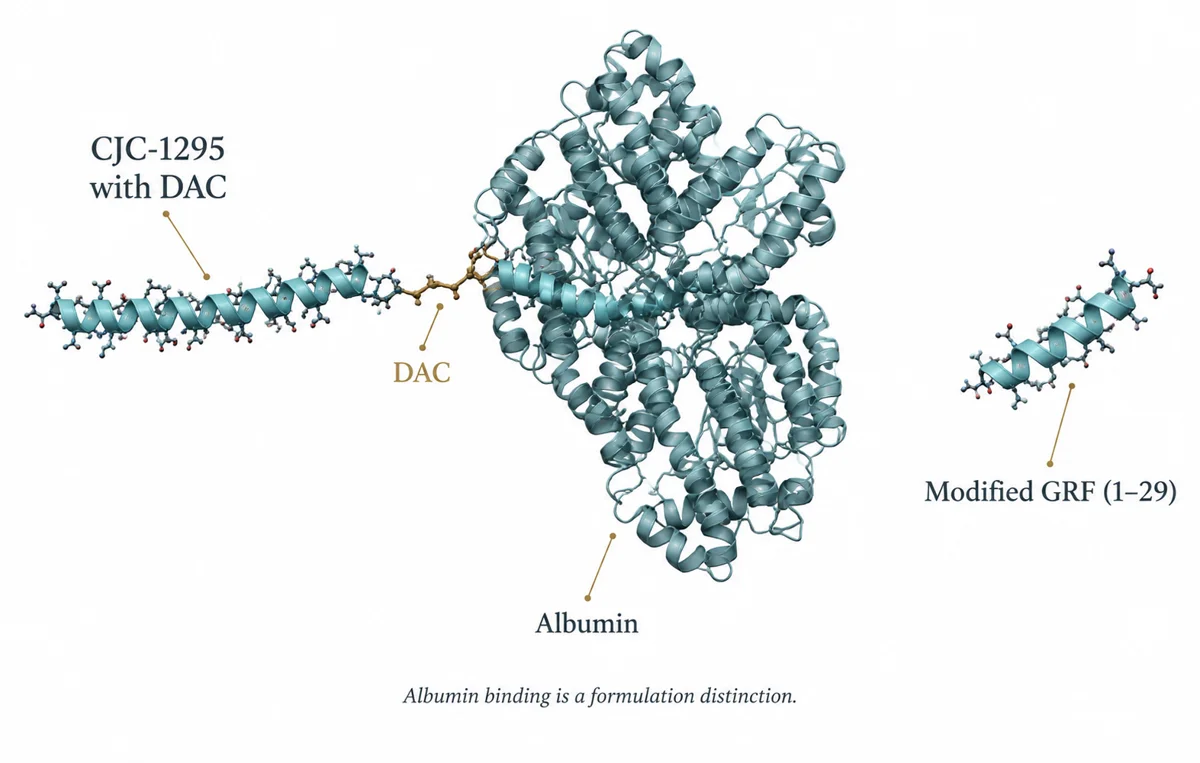
3. The Role of DAC and Albumin Binding
An important characteristic of the DAC-modified version of CJC-1295 is its ability to bind to albumin, one of the most abundant proteins in blood plasma.
DAC stands for Drug Affinity Complex.
This modification involves a reactive chemical group that allows the peptide to form a covalent attachment with albumin.
Albumin binding can influence:
- Circulating peptide persistence.
- Pharmacokinetic behaviour.
- Resistance to rapid clearance.
- Duration of biological exposure.
A 2006 human study by Teichman and colleagues investigated the long-acting DAC-modified compound and reported a substantially extended half-life.
It is important to distinguish this version from modified GRF (1-29), commonly marketed as CJC-1295 without DAC. The two should not be assumed to have identical pharmacokinetic properties.
CJC-1295 Mechanism: Simplified Overview
Molecular pathway:
CJC-1295 → GHRH receptor activation → Gs protein → Adenylyl cyclase → Increased cAMP → PKA activation → Regulation of GH synthesis and secretion.
The key scientific distinction is that CJC-1295 interacts with the GHRH-related signalling system rather than directly acting as growth hormone itself.
What Is the Mechanism of Action of Ipamorelin?
Ipamorelin operates through a different biological mechanism.
It is a synthetic pentapeptide classified as a growth hormone secretagogue. Its primary target is the growth hormone secretagogue receptor type 1a (GHS-R1a).
This receptor is also known as the ghrelin receptor because it responds to ghrelin, a naturally occurring hormone involved in appetite regulation, energy balance and endocrine signalling.
1. Interaction With the GHS-R1a Receptor
Ipamorelin acts as an agonist of GHS-R1a.
Unlike CJC-1295, which is structurally related to GHRH, Ipamorelin belongs to a different peptide family and interacts with the ghrelin receptor system.
GHS-R1a is expressed in several tissues, including regions of the hypothalamus and pituitary gland.
Its activation contributes to signalling processes associated with growth hormone secretion.
This makes Ipamorelin an interesting compound for studying how ghrelin-related pathways interact with the endocrine system.
2. Activation of Intracellular Signalling
GHS-R1a is a G protein-coupled receptor that can activate intracellular signalling involving Gq/11 proteins.
This pathway is associated with phospholipase C (PLC) activation.
The signalling process can be summarised as follows:
- Ipamorelin binds to GHS-R1a.
- Receptor activation stimulates associated G proteins.
- Phospholipase C becomes activated.
- PLC breaks down phosphatidylinositol 4,5-bisphosphate (PIP2).
- This produces two important signalling molecules: IP3 and DAG.
- IP3 contributes to the release of calcium from intracellular stores.
- Changes in intracellular calcium signalling contribute to cellular responses associated with growth hormone secretion.
These intracellular events help explain why Ipamorelin has a different mechanism from GHRH-related peptides.
3. Receptor Selectivity and Scientific Interest
Ipamorelin gained scientific attention partly because of its reported selectivity in early pharmacological research.
A study by Raun and colleagues, published in 1998 in the European Journal of Endocrinology, investigated its growth hormone-releasing properties.
Researchers compared Ipamorelin with other growth hormone secretagogues and examined its effects on several hormonal parameters in experimental models.
The findings contributed to the classification of Ipamorelin as a selective growth hormone secretagogue.
However, selectivity observed in preclinical studies should not automatically be interpreted as proof of long-term safety or identical effects in humans.
Ipamorelin Mechanism: Simplified Overview
Molecular pathway:
Ipamorelin → GHS-R1a activation → G-protein signalling → PLC activation → IP3 and DAG production → Intracellular calcium signalling → Regulation of GH secretion.
Its main distinction is its interaction with the ghrelin receptor rather than the GHRH receptor.
Different messages, different receptors
CJC-1295
GHRH analogue
- GHRH receptor
- Gs protein
- Adenylyl cyclase
- Increased cAMP
- PKA activation
- Regulation of GH synthesis and secretion
DAC-modified CJC-1295 binds albumin. Modified GRF (1–29), often called ‘without DAC’, is not interchangeable with the long-acting compound.
Simplified pathway diagram; not a potency comparison, clinical prediction, or administration guide.
CJC-1295 vs. Ipamorelin: Comparing Their Molecular Mechanisms
Although both compounds are investigated in relation to growth hormone regulation, their receptor interactions and downstream signalling processes are different.
The following comparison highlights their primary mechanistic distinctions.
| Scientific Feature | CJC-1295 | Ipamorelin |
|---|---|---|
| Peptide classification | GHRH analogue | Growth hormone secretagogue |
| Primary receptor | GHRH receptor | GHS-R1a |
| Receptor family | GPCR | GPCR |
| Main associated G protein | Gs | Gq/11 |
| Key signalling pathway | cAMP and PKA | PLC, IP3, DAG and calcium |
| Natural signalling counterpart | GHRH | Ghrelin |
| Primary research focus | GHRH-related endocrine signalling | Ghrelin-receptor-mediated signalling |
| Important structural feature | Modified GHRH-related sequence | Synthetic pentapeptide |
| DAC modification | Present in DAC-modified form | Not applicable |
One important point is that both receptors belong to the GPCR superfamily, but they activate different intracellular signalling pathways.
This distinction helps researchers investigate how separate molecular signals influence the same endocrine organ.
Why Do CJC-1295 and Ipamorelin Act Through Different Receptors?
The difference comes down to their molecular structures and the way receptors recognise specific chemical signals.
Receptors are specialised proteins that interact with particular molecules based on their structural and chemical characteristics.
CJC-1295 is designed around the molecular framework of GHRH. Its receptor interactions reflect the biological signalling system associated with that hormone.
Ipamorelin has a different amino acid sequence and molecular structure. It interacts with GHS-R1a, the receptor associated with ghrelin and related growth hormone secretagogues.
This demonstrates an important principle in molecular biology:
Different molecules can influence the same physiological process by activating entirely different receptors.
The distinction is useful in research involving:
- Receptor pharmacology.
- Hormone secretion.
- Intracellular communication.
- Endocrine feedback mechanisms.
- Peptide structure and biological activity.
Understanding the Potential Interaction Between the Two Signalling Pathways
One of the most interesting aspects of comparing CJC-1295 and Ipamorelin is that their respective receptor pathways are involved in regulating the same pituitary cell population.
GHRH and ghrelin-related signalling can influence growth hormone secretion through distinct but interconnected mechanisms.
Earlier experimental studies involving GHRH and growth hormone-releasing peptides such as GHRP-6 demonstrated that activating different receptor systems could produce enhanced growth hormone responses.
This suggests that communication between separate signalling pathways can be an important feature of endocrine regulation.
However, an important scientific distinction must be maintained.
Research involving GHRH and other secretagogues does not establish the clinical effectiveness of combining CJC-1295 and Ipamorelin.
The specific combination requires its own controlled pharmacological and clinical investigation.
Mechanistic similarity is not the same as direct clinical evidence.
What Does Scientific Research Tell Us About These Mechanisms?
Published research provides different levels of evidence for the two compounds.
CJC-1295 Research
A notable study published in 2006 in the Journal of Clinical Endocrinology & Metabolism investigated the pharmacokinetics and pharmacodynamic effects of CJC-1295 in healthy adults.
Researchers reported prolonged increases in circulating growth hormone and IGF-1 concentrations following administration of the studied DAC-modified compound.
The estimated half-life was approximately 5.8–8.1 days.
This study provided important evidence about the pharmacokinetic behaviour of the long-acting GHRH analogue.
It also demonstrated why albumin binding is an important consideration when examining the molecular design of modified peptide compounds.
Ipamorelin Research
A foundational study published by Raun and colleagues in 1998 examined Ipamorelin's pharmacological characteristics.
The research investigated its growth hormone-releasing activity and selectivity in experimental models.
The findings helped establish Ipamorelin as a distinct growth hormone secretagogue acting through the ghrelin-related receptor pathway.
Its receptor activity provides an important example of how a synthetic peptide can influence endocrine signalling without being structurally related to GHRH.
Two papers · different research questions
2006
CJC-1295 with DAC
- Study model
- Healthy adults
- Measured outcomes
- GH / IGF-1 concentrations and pharmacokinetics
- Evidence boundary
- Early human hormone-marker findings; not long-term clinical benefit.
1998
Ipamorelin
- Study model
- Preclinical cells and animal models
- Measured outcomes
- GH release and secretagogue selectivity
- Evidence boundary
- This cited study does not establish human therapeutic outcomes.
| Studied compound | Estimated half-life | Source and boundary |
|---|---|---|
| DAC-modified CJC-1295 | Approximately 5.8–8.1 days | Teichman et al. (2006), healthy adults; does not apply automatically to modified GRF (1–29). |
| Ipamorelin | Not inferred from the cited selectivity study | Raun et al. (1998) investigated preclinical pharmacology, not a comparable human half-life endpoint. |
Why Evidence Must Be Interpreted Carefully
The available research should be considered in context.
Evidence from laboratory experiments, animal models and human clinical studies answers different scientific questions.
An observed change in hormone concentrations does not automatically establish improvements in health, physical performance, recovery or longevity.
Further research is necessary to understand the full biological implications of these compounds.
Conclusion: Two Different Molecular Pathways, One Important Area of Research
CJC-1295 and Ipamorelin provide two distinct examples of how synthetic peptides can interact with the endocrine system through different molecular mechanisms.
CJC-1295 is associated with GHRH receptor activation and the downstream cAMP/PKA signalling pathway. Ipamorelin acts through the GHS-R1a receptor, involving PLC-mediated signalling and intracellular calcium mobilisation.
Although both compounds are investigated in connection with growth hormone regulation, their molecular structures, receptor targets and intracellular signalling processes are fundamentally different.
Understanding these differences is important for interpreting peptide pharmacology and appreciating the complexity of endocrine regulation.
As scientific investigation continues, receptor interactions, pharmacokinetics, pathway communication and long-term safety remain important areas for further study.
At HelixForge Research, we aim to make complex molecular biology and peptide research easier to understand through evidence-based educational resources and accessible scientific explanations.
Educational only. Molecular mechanisms do not establish clinical efficacy or safety, and this article is not medical advice or an administration guide. Check current Canadian regulatory requirements with Health Canada.
Frequently asked questions
What is the main difference between CJC-1295 and Ipamorelin mechanisms?
CJC-1295 interacts with the GHRH receptor and is primarily associated with Gs/cAMP/PKA signalling. Ipamorelin activates the GHS-R1a ghrelin receptor and is associated with Gq/11, PLC and intracellular calcium signalling.
Does CJC-1295 activate the ghrelin receptor?
No. CJC-1295 is a GHRH analogue and acts through the GHRH receptor pathway. The ghrelin receptor is the primary target associated with Ipamorelin.
Does Ipamorelin activate the GHRH receptor?
No. Ipamorelin interacts with GHS-R1a rather than the GHRH receptor. Its molecular structure and receptor activity are different from those of GHRH analogues.
What is the cAMP pathway in peptide research?
The cAMP pathway is an intracellular signalling system that helps cells respond to external chemical signals. In GHRH-related signalling, receptor activation stimulates adenylyl cyclase, increasing cAMP and activating protein kinase A.
What is the role of calcium signalling in Ipamorelin activity?
Activation of GHS-R1a can stimulate phospholipase C signalling, generating IP3 and DAG. IP3 contributes to calcium mobilisation from intracellular stores, which participates in downstream cellular responses.
Why is CJC-1295 with DAC different from CJC-1295 without DAC?
The DAC modification enables albumin binding, which extends the circulation time of the modified compound. Modified GRF (1-29), commonly called CJC-1295 without DAC, does not have this same modification.
Are CJC-1295 and Ipamorelin the same type of peptide?
No. CJC-1295 is a GHRH analogue, whereas Ipamorelin is a synthetic pentapeptide growth hormone secretagogue. They belong to different functional peptide classes.
Have the mechanisms of CJC-1295 and Ipamorelin been studied together?
Their individual mechanisms have been investigated separately, while related research has examined interactions between GHRH and other growth hormone secretagogues. The specific combination of CJC-1295 and Ipamorelin should not be considered clinically validated based on those related studies.
What is the difference between a peptide receptor and a hormone?
A hormone is a chemical messenger that communicates biological information between cells or tissues. A receptor is a specialised protein that recognises and responds to a particular signal, initiating downstream cellular activity.
Why are researchers interested in GPCR signalling?
G protein-coupled receptors regulate numerous physiological processes, including hormone secretion, metabolism, cellular communication and nervous system activity. Studying their signalling pathways helps scientists understand how different molecules influence biological functions.
References
- Teichman et al. (2006). Prolonged stimulation of growth hormone and IGF-I secretion by CJC-1295 in healthy adults., Journal of Clinical Endocrinology & Metabolism
- Jetté et al. (2005). Human growth hormone-releasing factor (hGRF)1–29-albumin bioconjugates activate the GRF receptor in rats., Endocrinology
- Raun et al. (1998). Ipamorelin, the first selective growth hormone secretagogue., European Journal of Endocrinology
- Howard et al. (1996). A receptor in pituitary and hypothalamus that functions in growth hormone release., Science
- Kojima et al. (1999). Ghrelin is a growth-hormone-releasing acylated peptide from stomach., Nature
- Drugs and health products, Health Canada
Research Disclaimer. HelixForge Research content is for educational and informational purposes only. It is not medical advice and does not describe the safety or effectiveness of any product for human use. All HelixForge products are for research use only. See our scientific disclaimer and editorial policy.
Related research
Peptide Research & Scientific Comparisons
CJC-1295 vs. Ipamorelin: Understanding Their Differences
Explore CJC-1295 vs. Ipamorelin, their mechanisms of action, differences in growth hormone signalling, scientific research and safety considerations.
Peptide Science
How Do Peptides Work at a Scientific Level?
How peptides interact with receptors, enzymes and cells at the molecular level — from binding and signalling to breakdown — and why structure decides everything.

Peptide Science
What Are Peptides? A Complete Guide to Understanding Peptides, Their Structure, Functions and Research
Learn what peptides are, how amino acids form peptide bonds, how peptides work, and how researchers assess identity, purity and laboratory documentation.
Contact the HelixForge Team
Let's Talk Science.
Have a question about an article or a topic you'd like us to explore? Say Hi to the HelixForge Team.
Stay Updated on Research
Receive research insights, scientific updates, and educational resources from HelixForge Research.