
CJC-1295 vs. Ipamorelin: Understanding Their Differences

By Shaun · Published November 20, 2026 · 8 min read
Listen to this article
Device narration · estimated timeline
Device narration · voice quality depends on your browser and installed voices.
Quick Answer
CJC-1295 is a GHRH analogue acting through GHRH-receptor signalling; ipamorelin is a pentapeptide agonist of the ghrelin receptor GHS-R1a. Both are investigated upstream of growth hormone release, but neither is HGH. DAC-modified CJC-1295 is not interchangeable with modified GRF (1–29), often marketed as “CJC-1295 without DAC”. Different mechanisms and early research findings do not establish comparative clinical benefit or safety.
Key Takeaways
- Different receptors: GHRH receptor for CJC-1295; GHS-R1a for ipamorelin.
- DAC enables albumin binding; “without DAC” commonly names a different GHRH-related molecule.
- Human hormone-marker findings and preclinical selectivity studies are not a head-to-head comparison.
- Neither peptide is human growth hormone, and research availability does not establish therapeutic approval.
Introduction
Peptide research continues to attract scientific interest, particularly in the study of hormones, cellular communication and the body's complex endocrine system. Among the compounds frequently discussed in this field are CJC-1295 and Ipamorelin, two synthetic peptides investigated for their relationship with growth hormone (GH) signalling.
For the fundamentals, explore what peptides are and how peptides work at a scientific level.
Although both compounds are associated with the regulation of growth hormone, they interact with different biological pathways. CJC-1295 is a synthetic analogue of growth hormone-releasing hormone (GHRH), while Ipamorelin belongs to a different class of compounds known as growth hormone secretagogues.
Understanding the differences between CJC-1295 vs. Ipamorelin requires looking beyond their shared research focus. Their molecular structures, receptor interactions, mechanisms of action and available scientific evidence are distinct.
This article explores how these two peptides differ, what researchers have investigated and why understanding their individual mechanisms matters in modern peptide science.
What Is CJC-1295?
CJC-1295 is a synthetic peptide analogue of growth hormone-releasing hormone (GHRH). It was developed to investigate how modifying GHRH-related molecules could influence growth hormone signalling and extend biological activity.
GHRH is a naturally occurring hormone produced in the hypothalamus. It plays an important role in regulating growth hormone release from the anterior pituitary gland.
CJC-1295 was designed with structural modifications that influence its interaction with the biological systems responsible for growth hormone regulation.
One important distinction in peptide research is the difference between CJC-1295 with Drug Affinity Complex (DAC) and versions commonly described as CJC-1295 without DAC.
CJC-1295 With DAC
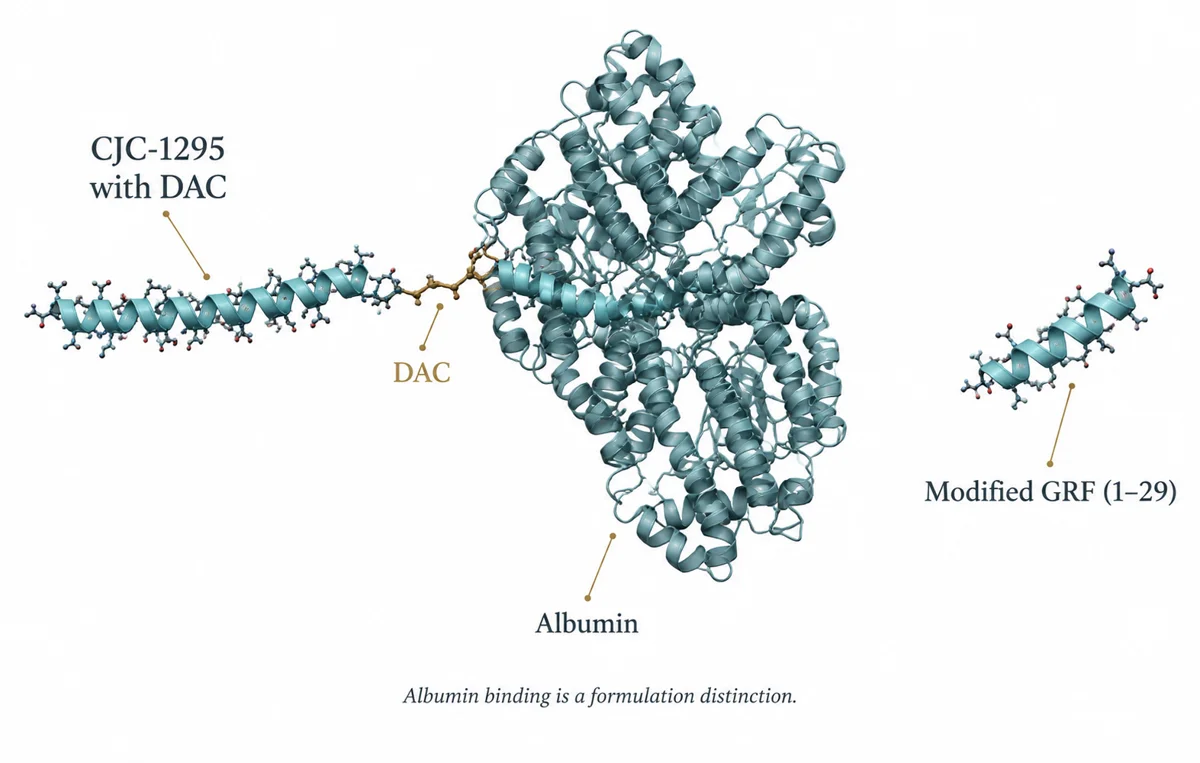
The DAC modification enables the compound to bind to albumin, a protein naturally present in blood plasma.
This interaction can extend the compound's circulation time compared with shorter-acting GHRH analogues.
In a published human study, researchers investigated CJC-1295 and observed prolonged increases in growth hormone and insulin-like growth factor 1 (IGF-1). The findings provided important insights into the potential for modifying GHRH analogues to influence endocrine signalling over an extended period.
CJC-1295 Without DAC
The term CJC-1295 without DAC is commonly used in peptide research markets to describe modified GRF (1-29), also known as tetrasubstituted GRF (1-29).
Unlike the DAC-modified compound, this version does not have the same albumin-binding modification.
It is therefore important not to treat CJC-1295 with DAC and modified GRF (1-29) as interchangeable compounds when examining scientific literature.
What Is Ipamorelin?
Ipamorelin is a synthetic pentapeptide that belongs to a class of compounds known as growth hormone secretagogues.
Unlike CJC-1295, which is based on GHRH, Ipamorelin is associated with the ghrelin receptor pathway.
It acts as an agonist of the growth hormone secretagogue receptor type 1a (GHS-R1a), a receptor involved in regulating growth hormone release.
The ghrelin receptor is part of a broader biological signalling system associated with energy balance, appetite regulation and endocrine activity.
Ipamorelin has attracted scientific interest because researchers have investigated its ability to stimulate growth hormone release while examining its selectivity compared with other growth hormone secretagogues.
Its distinct receptor pathway makes it particularly interesting when studying the differences between GHRH-related signalling and ghrelin-receptor-mediated activity.
CJC-1295 vs. Ipamorelin: Key Differences at a Glance
The most important difference between CJC-1295 and Ipamorelin is their mechanism of action.
| Feature | CJC-1295 | Ipamorelin |
|---|---|---|
| Peptide classification | GHRH analogue | Growth hormone secretagogue |
| Molecular structure | Modified GHRH-related peptide | Synthetic pentapeptide |
| Primary receptor pathway | GHRH receptor | GHS-R1a |
| Main research focus | GHRH-related signalling | Ghrelin-receptor signalling |
| Biological target | Pituitary GH regulation | Pituitary GH regulation |
| DAC modification | Available in DAC-modified form | No equivalent DAC modification |
| Research interest | GH and IGF-1 regulation | Selective GH secretion |
| Key distinction | GHRH pathway | Ghrelin receptor pathway |
Both compounds are studied in connection with growth hormone regulation, but they approach this biological process through different receptor systems.
How Do CJC-1295 and Ipamorelin Work?
To understand the difference between these compounds, it is helpful to examine the biological pathways involved in growth hormone regulation.
The pituitary gland does not operate independently. It receives regulatory signals from the hypothalamus and responds to several hormones and signalling molecules.
Two important pathways involved in this process are the GHRH pathway and the ghrelin receptor pathway.
1. CJC-1295 and the GHRH Pathway
CJC-1295 is designed around the biological activity of GHRH.
Under normal physiological conditions, GHRH binds to GHRH receptors located on somatotroph cells in the anterior pituitary gland.
This interaction activates intracellular signalling, including the cyclic adenosine monophosphate (cAMP) pathway.
The resulting cellular activity contributes to the regulation and release of growth hormone.
CJC-1295 is investigated for its ability to interact with this same regulatory pathway.
The DAC modification adds another research dimension by allowing albumin binding, which can influence the compound's pharmacokinetic profile.
2. Ipamorelin and the Ghrelin Receptor Pathway
Ipamorelin operates through a different mechanism.
It acts on GHS-R1a, a receptor associated with the biological activity of ghrelin.
When this receptor is activated, intracellular signalling involving pathways such as phospholipase C and calcium mobilisation can contribute to growth hormone release.
This means Ipamorelin does not simply replicate the activity of GHRH.
Instead, it interacts with another regulatory system involved in pituitary hormone secretion.
Understanding the Two Pathways
Different messages, different receptors
CJC-1295
GHRH analogue
- GHRH receptor
- Gs protein
- Adenylyl cyclase
- Increased cAMP
- PKA activation
- Regulation of GH synthesis and secretion
DAC-modified CJC-1295 binds albumin. Modified GRF (1–29), often called ‘without DAC’, is not interchangeable with the long-acting compound.
Simplified pathway diagram; not a potency comparison, clinical prediction, or administration guide.
Simplified scientific pathway comparison:
CJC-1295:
GHRH analogue → GHRH receptor → Intracellular cAMP signalling → Regulation of GH release
Ipamorelin:
Ghrelin receptor agonist → GHS-R1a activation → Intracellular signalling and calcium mobilisation → Regulation of GH release
These pathways demonstrate why the two peptides are scientifically distinct, despite their shared association with growth hormone.
CJC-1295 vs. Ipamorelin: What Does Scientific Research Say?
Scientific studies provide a useful foundation for understanding these compounds, although the amount and type of available evidence differ.
Research on CJC-1295
A notable human clinical study published in 2006 investigated the effects of CJC-1295 on growth hormone and IGF-1 concentrations.
Researchers reported prolonged increases in circulating growth hormone and IGF-1 following administration of the studied compound.
The study helped establish scientific interest in long-acting GHRH analogues and demonstrated how albumin-binding modifications can influence peptide pharmacokinetics.
However, changes in hormone concentrations do not automatically establish long-term clinical benefits or safety.
Research on Ipamorelin
Ipamorelin has been investigated in preclinical studies examining its growth hormone-releasing properties.
Research published in the European Journal of Endocrinology in 1998 explored the compound's pharmacological characteristics and its selectivity as a growth hormone secretagogue.
Researchers examined its ability to stimulate growth hormone release while investigating its effects on other hormonal pathways.
These studies contributed to scientific understanding of ghrelin-receptor agonists and their potential role in endocrine research.
Importantly, findings from laboratory and animal studies cannot automatically be translated into established human clinical outcomes.
Two papers · different research questions
2006
CJC-1295 with DAC
- Study model
- Healthy adults
- Measured outcomes
- GH / IGF-1 concentrations and pharmacokinetics
- Evidence boundary
- Early human hormone-marker findings; not long-term clinical benefit.
1998
Ipamorelin
- Study model
- Preclinical cells and animal models
- Measured outcomes
- GH release and secretagogue selectivity
- Evidence boundary
- This cited study does not establish human therapeutic outcomes.
Why Are Researchers Interested in Their Different Mechanisms?
One reason CJC-1295 and Ipamorelin remain subjects of scientific discussion is that growth hormone regulation involves several interconnected biological systems.
Studying different receptor pathways helps researchers understand how the endocrine system responds to distinct molecular signals.
The GHRH pathway and ghrelin receptor pathway are not identical. They involve different receptors, intracellular signalling mechanisms and regulatory processes.
Investigating these differences may help scientists better understand:
- How different receptors influence pituitary hormone secretion.
- How peptide modifications affect biological activity.
- How albumin binding changes peptide pharmacokinetics.
- How growth hormone regulation interacts with other endocrine signals.
- Why different growth hormone secretagogues can produce different research findings.
These questions are relevant to broader investigations into hormone signalling and peptide pharmacology.
Are CJC-1295 and Ipamorelin the Same as HGH?
No. CJC-1295, Ipamorelin and human growth hormone (HGH) are different substances.
Human growth hormone is a naturally occurring peptide hormone produced by the anterior pituitary gland.
CJC-1295 is a synthetic GHRH analogue, while Ipamorelin is a synthetic growth hormone secretagogue that acts through the ghrelin receptor.
The distinction is important because these compounds interact with the body's growth hormone regulatory system rather than being identical to the hormone itself.
| Compound | Classification | Primary biological role |
|---|---|---|
| Human Growth Hormone | Peptide hormone | Directly acts on GH receptors |
| CJC-1295 | GHRH analogue | Investigates GHRH-related signalling |
| Ipamorelin | Growth hormone secretagogue | Activates GHS-R1a |
Understanding these differences is essential when interpreting scientific publications involving growth hormone and related compounds.
Safety, Regulatory Considerations and Research Limitations
Safety is an important consideration in all areas of peptide research.
Although CJC-1295 and Ipamorelin have been investigated in scientific studies, the available evidence does not establish either compound as a generally approved treatment for human use.
Research findings should be interpreted according to the study design, species involved, sample size, duration and measured outcomes.
Potential areas requiring further investigation include:
- Long-term effects of altered growth hormone signalling.
- Changes in IGF-1 concentrations.
- Endocrine feedback mechanisms.
- Receptor selectivity and downstream signalling.
- Pharmacokinetic differences between peptide formulations.
- Potential adverse effects and interactions.
Canadian Regulatory Context
In Canada, Health Canada regulates drugs and health products, including medicines and certain peptide-related products, under the Food and Drugs Act.
The regulatory status of a substance depends on its classification, intended use, formulation and applicable regulatory requirements.
Researchers and consumers should not assume that a compound is approved for human therapeutic use simply because it is discussed in scientific literature or offered through a research-oriented supplier.
For current information, consult Health Canada and the Drug Product Database.
HelixForge Research focuses on scientific education and research information. Research materials should not be interpreted as instructions for human administration, diagnosis or treatment.
Conclusion: Understanding Two Different Approaches to Growth Hormone Research
CJC-1295 and Ipamorelin are two distinct synthetic peptides that have attracted scientific interest because of their relationship with growth hormone regulation.
CJC-1295 is based on GHRH-related signalling, while Ipamorelin interacts with the ghrelin receptor pathway. Their different molecular structures and receptor interactions provide researchers with opportunities to investigate how separate biological systems contribute to pituitary hormone regulation.
Understanding CJC-1295 vs. Ipamorelin requires examining the underlying science rather than treating the two compounds as interchangeable.
As peptide research continues to evolve, further investigation into receptor activity, pharmacokinetics, endocrine feedback and long-term safety will remain important.
At HelixForge Research, our goal is to make complex peptide science easier to understand through research-focused educational content, scientific context and accessible explanations.
Frequently asked questions
What is the main difference between CJC-1295 and Ipamorelin?
The main difference is their receptor pathway. CJC-1295 is a GHRH analogue that interacts with GHRH-related signalling, while Ipamorelin activates the ghrelin receptor GHS-R1a. Both are investigated in relation to growth hormone regulation.
Does CJC-1295 work through the same receptor as Ipamorelin?
No. CJC-1295 is associated with the GHRH receptor pathway, whereas Ipamorelin acts as an agonist of the GHS-R1a receptor. These are two separate biological signalling systems.
What is the difference between CJC-1295 with DAC and without DAC?
CJC-1295 with DAC contains a Drug Affinity Complex modification that enables albumin binding and extends its circulation time. The term CJC-1295 without DAC is commonly used for modified GRF (1-29), which lacks this albumin-binding modification.
Is Ipamorelin a GHRH analogue?
No. Ipamorelin is a synthetic pentapeptide classified as a growth hormone secretagogue. It acts through the ghrelin receptor rather than the GHRH receptor.
Do CJC-1295 and Ipamorelin directly contain human growth hormone?
No. Neither compound is human growth hormone. They are synthetic peptides investigated for their interactions with biological pathways involved in growth hormone regulation.
What is the relationship between growth hormone and IGF-1?
Growth hormone can stimulate the production of insulin-like growth factor 1 (IGF-1), particularly in the liver. IGF-1 participates in several biological processes involving growth, development and cellular regulation.
Are CJC-1295 and Ipamorelin authorized drugs in Canada?
Their regulatory status should be checked against current Health Canada requirements. Neither should be assumed to be an approved therapeutic medicine for human use simply because scientific research exists.
Why are CJC-1295 and Ipamorelin frequently discussed together?
They are frequently discussed together because both are associated with growth hormone regulation. However, their different receptor pathways make them useful examples for studying distinct mechanisms of endocrine signalling.
References
- Teichman et al. (2006). Prolonged stimulation of growth hormone (GH) and insulin-like growth factor I secretion by CJC-1295, a long-acting GHRH analog, in healthy adults., Journal of Clinical Endocrinology & Metabolism
- Raun et al. (1998). Ipamorelin, the first selective growth hormone secretagogue., European Journal of Endocrinology
- Drugs and health products, Health Canada
- Biomedical literature search and further reading, National Library of Medicine, PubMed
Research Disclaimer. HelixForge Research content is for educational and informational purposes only. It is not medical advice and does not describe the safety or effectiveness of any product for human use. All HelixForge products are for research use only. See our scientific disclaimer and editorial policy.
Related research
Peptide Science
How Do Peptides Work at a Scientific Level?
How peptides interact with receptors, enzymes and cells at the molecular level — from binding and signalling to breakdown — and why structure decides everything.

Peptide Science
What Are Peptides? A Complete Guide to Understanding Peptides, Their Structure, Functions and Research
Learn what peptides are, how amino acids form peptide bonds, how peptides work, and how researchers assess identity, purity and laboratory documentation.
Research Documentation
How to Read a Certificate of Analysis (CoA)
A section-by-section walkthrough of the document that records a batch's test results.
Contact the HelixForge Team
Let's Talk Science.
Have a question about an article or a topic you'd like us to explore? Say Hi to the HelixForge Team.
Stay Updated on Research
Receive research insights, scientific updates, and educational resources from HelixForge Research.