
GHK-Cu vs. KLOW: Understanding Copper Peptides and Their Research Potential

By Shaun · Published November 12, 2026 · 12 min read
Listen to this article
Device narration · estimated timeline
Device narration · voice quality depends on your browser and installed voices.
Quick Answer
GHK-Cu is a defined copper-binding tripeptide with substantial preclinical research and limited human evidence. KLOW is a combination-product name, not a universally standardised peptide. Ingredient research cannot establish the safety or effectiveness of a finished blend.
Key Takeaways
- GHK-Cu consists of the Gly-His-Lys tripeptide associated with copper.
- KLOW has no universal formulation; verify each product individually.
- GHK-Cu evidence is largely preclinical, with limited human studies.
- Ingredient-level evidence does not establish combination effects.
- Australian TGA testing of one KLOW-labelled product found no detectable TB-500; that finding is product-specific.
Introduction: Why Are GHK-Cu and KLOW Being Discussed in Peptide Research?
Copper peptides have attracted growing attention in skin biology, tissue research and regenerative science. Among the names appearing in online discussions are GHK-Cu and KLOW. Although the two are often discussed together, they are not necessarily the same type of peptide product.
GHK-Cu is a copper-binding tripeptide that has been investigated in laboratory and preclinical research involving skin biology, collagen-related processes, inflammation and tissue repair. KLOW, by contrast, is a name used for combination peptide formulations. Its exact composition may depend on the manufacturer or product.
Understanding the difference matters. Research findings about GHK-Cu cannot automatically be applied to a multi-ingredient KLOW formulation. Each ingredient, combination and finished product requires its own scientific evaluation.
This article examines what GHK-Cu is, how KLOW products are described, what current research can and cannot tell us, and what Canadian readers should understand about safety and regulation.
For the scientific foundations, read What Are Peptides?. Compare this evidence with BPC-157 vs. TB-500 and learn how to read a Certificate of Analysis.
Quick answer: GHK-Cu is a defined copper-binding tripeptide with a substantial preclinical research history and limited human evidence. KLOW is a combination-product name rather than one universally standardised peptide, so its ingredients and evidence must be assessed individually.
1. What Is GHK-Cu?
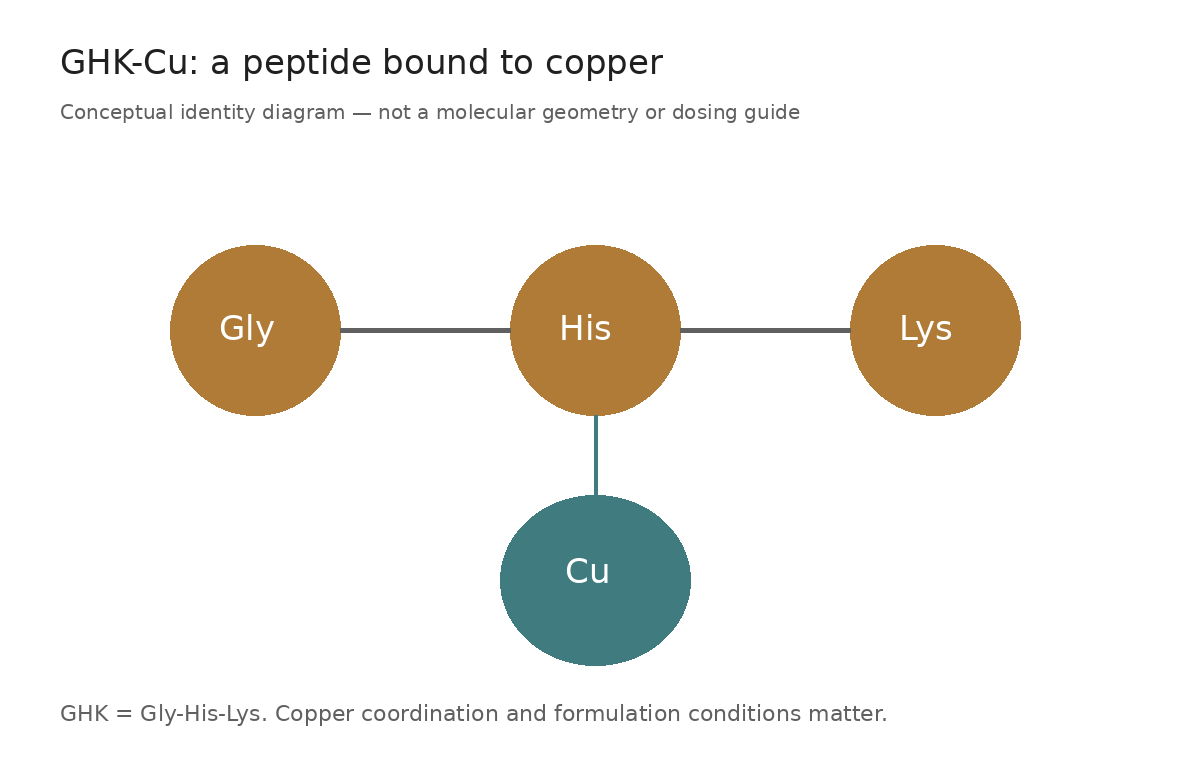
GHK-Cu is the copper complex of the naturally occurring tripeptide glycyl-L-histidyl-L-lysine (GHK). A tripeptide contains three amino acids, and GHK has the sequence:
- Glycine (Gly)
- Histidine (His)
- Lysine (Lys)
The peptide can bind copper ions, forming the complex commonly known as GHK-Cu or copper tripeptide-1.
GHK has been identified in human biological systems, including blood plasma. Researchers have investigated how its interaction with copper may influence cellular signalling and processes associated with tissue maintenance.
What does copper do in biological systems?
Copper is an essential trace element involved in several biological functions. It acts as a cofactor for enzymes involved in processes such as antioxidant defence, energy production and connective-tissue biology.
GHK-Cu is of scientific interest because it combines a short peptide sequence with copper-binding properties. Researchers are investigating how this complex interacts with biological pathways, rather than treating copper or the peptide as interchangeable with the complete complex.
Areas of GHK-Cu research
Scientific investigations have explored several potential research areas:
- Skin biology: Cellular processes involved in skin structure and maintenance.
- Collagen-related pathways: Biological signalling associated with extracellular matrix proteins.
- Wound research: Cellular migration and tissue-remodelling processes in experimental models.
- Inflammatory signalling: Possible effects on pathways involved in inflammatory responses.
- Oxidative stress: Interactions with biological systems that regulate oxidative balance.
- Hair and follicle research: Early investigation into possible effects on follicular biology.
These are research topics, not proof that GHK-Cu can treat a medical condition or produce a particular cosmetic result in people.
2. What Is KLOW?
KLOW is a name used for combination peptide formulations discussed in some research and online peptide communities. Unlike GHK-Cu, it does not identify one universally established peptide sequence.
A formulation labelled KLOW may contain several ingredients. For example, the Therapeutic Goods Administration (TGA) reported that a particular Synedica-branded KLOW 80 mg product was labelled as containing:
- GHK-Cu
- BPC-157
- TB-500
- KPV
- Vitamin B12
The TGA's laboratory testing found no detectable TB-500 in that tested product. This is a finding about the specific product tested; it should not be interpreted as proof that every product sold under the KLOW name has the same formulation or composition.
This distinction is important when evaluating research. A combination product containing multiple ingredients cannot be assumed to have the same biological activity, safety profile or evidence base as any one ingredient on its own.
Why do combination formulations attract research interest?
Combination formulations raise questions about how different ingredients may interact. Researchers may investigate:
- Whether individual components influence overlapping biological pathways.
- Whether combining ingredients changes their stability or chemical behaviour.
- Whether one component affects the activity or availability of another.
- Whether the complete formulation behaves differently from its individual ingredients.
- Whether the combination introduces additional safety or quality concerns.
However, a theoretical rationale is not the same as demonstrated clinical effectiveness. Each combination requires appropriate analytical testing and controlled research.
3. GHK-Cu vs. KLOW: Key Differences
The most important distinction is that GHK-Cu is a defined copper-binding peptide complex, whereas KLOW is a product or formulation name that may refer to a mixture of ingredients.
| Comparison | GHK-Cu | KLOW |
|---|---|---|
| Identity | Defined copper-binding tripeptide complex | Name used for combination formulations |
| Composition | GHK peptide bound to copper | Depends on the specific formulation |
| Structure | Gly-His-Lys associated with copper | No single universal sequence |
| Research history | Investigated in laboratory, preclinical and limited human studies | Evidence must be assessed for each formulation |
| Research interests | Skin biology, collagen-related pathways, tissue repair and inflammation | Depends on the ingredients included |
| Evidence interpretation | Findings relate to the specific GHK-Cu material and study conditions | Evidence for individual ingredients does not establish effects of the whole blend |
| Product consistency | Depends on identity, purity and manufacturing quality | Requires verification of every ingredient and its quantity |
| Canadian regulatory position | Unapproved as a therapeutic peptide product unless a specific lawful approval or exemption applies | Same principle applies to products promoted for therapeutic purposes |
Key point: GHK-Cu and KLOW should not be treated as interchangeable. A study involving GHK-Cu alone does not establish the safety or effectiveness of a KLOW combination product.
4. How Does GHK-Cu Interact With Biological Systems?
GHK-Cu is studied partly because copper-binding peptides may interact with several cellular and biochemical processes.
Researchers have investigated its relationship with gene expression, extracellular matrix biology, antioxidant systems and cellular responses to tissue injury.
4.1 Extracellular matrix and collagen research
The extracellular matrix is the network of proteins and other molecules that surrounds cells and contributes to tissue structure. Collagen is one of its major components.
GHK-Cu has been investigated for its potential influence on pathways associated with extracellular matrix maintenance and remodelling. These findings are relevant to skin and connective-tissue research.
However, changes in laboratory markers do not automatically translate into visible or clinically meaningful improvements in human tissue.
4.2 Cellular signalling and tissue remodelling
Experimental research has explored whether GHK-Cu influences cellular signalling involved in migration, organisation and tissue remodelling.
These processes are complex. Their outcomes depend on the biological environment, concentration, delivery method and characteristics of the experimental model.
4.3 Oxidative stress and inflammatory pathways
Oxidative stress occurs when reactive molecules exceed the capacity of biological antioxidant systems to regulate them. Inflammation is a normal biological response, but its duration and intensity are important.
GHK-Cu has been investigated in relation to pathways associated with oxidative balance and inflammatory signalling. More controlled human research is needed to establish whether these findings have meaningful clinical implications.
5. What Does the Research Say About GHK-Cu?
GHK-Cu has a longer research history than many newer combination formulations. Its literature includes laboratory experiments, animal studies, formulation research and a relatively small amount of human research.
A 2026 review in Pharmaceutics examined GHK-Cu's coordination chemistry, formulation science, biological evidence and potential delivery systems. It highlighted an important limitation: the larger preclinical literature should not be confused with a strong body of human clinical evidence.
What has been investigated?
| Research area | What researchers have examined | Evidence interpretation |
|---|---|---|
| Skin biology | Cellular responses and skin-related processes | Mainly experimental, with limited human research |
| Collagen pathways | Extracellular matrix and connective-tissue signalling | Promising research interest; clinical significance remains uncertain |
| Wound models | Cellular activity and tissue-remodelling processes | Predominantly preclinical |
| Inflammatory pathways | Changes in selected biological signalling markers | Requires further human investigation |
| Oxidative stress | Interactions with antioxidant-related systems | Mainly laboratory and mechanistic evidence |
| Hair biology | Early cosmetic and follicular research | Limited human evidence; not conclusive |
Are there human studies on GHK-Cu?
Yes, but the human evidence remains limited. Some research has examined topical cosmetic formulations and skin-related outcomes. These studies differ in design, sample size, formulation and measurement methods.
A small study involving a cosmetic formulation does not establish that every GHK-Cu product will produce the same result. It also does not establish the safety or effectiveness of injectable or other delivery formats.
The 2026 scientific literature continues to identify gaps in clinical research, including the need for larger, well-controlled trials and better characterisation of the actual GHK-Cu material used.
6. What Does the Research Say About KLOW?
KLOW requires a different approach to evidence evaluation because it is a combination-product label rather than a single defined molecule.
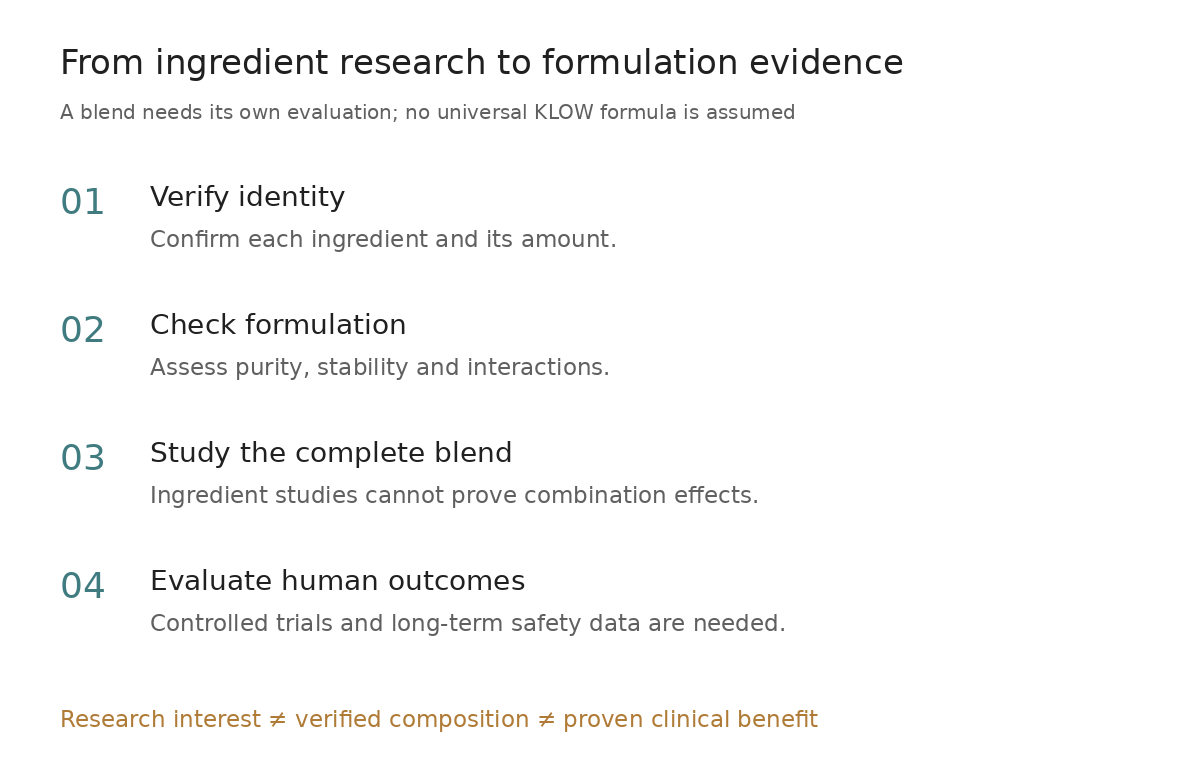
If a formulation contains GHK-Cu, BPC-157, TB-500, KPV and vitamin B12, each ingredient has a separate research history and scientific profile. However, evidence about one component cannot establish the effects of the complete combination.
Why ingredient-level research is not enough
Suppose researchers investigate GHK-Cu in a laboratory model. That study does not answer whether a five-ingredient formulation:
- Contains the ingredients stated on its label.
- Contains the stated amount of each ingredient.
- Remains chemically stable when ingredients are combined.
- Produces the same biological effects as the individual components.
- Has an acceptable safety profile.
- Produces measurable benefits in a properly controlled human trial.
These questions require testing of the finished formulation itself.
Why formulation verification matters
The TGA's November 2026 safety advisory provides a relevant international example. Testing of a specific Synedica-branded KLOW 80 mg product found no detectable TB-500, despite the ingredient being listed on the label.
This finding illustrates why product identity and analytical verification matter in peptide research. A label is not independent proof of what a product contains.
7. GHK-Cu vs. KLOW: Research Evidence at a Glance
The following table summarises the current evidence landscape without assigning unsupported numerical scores.
| Evidence question | GHK-Cu | KLOW |
|---|---|---|
| Is the substance clearly defined? | Yes, as a copper-binding GHK tripeptide complex | No single standard formulation |
| Is there laboratory research? | Yes | Depends on the formulation and its components |
| Is there preclinical research? | Yes | Individual ingredients may have separate preclinical studies |
| Is there human research? | Limited studies exist | Robust formulation-specific evidence is not established |
| Can ingredient studies prove combination effects? | Not applicable to the single complex | No |
| Are long-term safety data established? | No | No |
| Is it an authorized drug in Canada? | Not established as an approved therapeutic peptide product | Not established as an approved therapeutic peptide product |
Evidence summary: GHK-Cu has a more clearly defined scientific identity and a longer standalone research history. KLOW requires formulation-specific evidence before claims about the complete combination can be evaluated.

8. Safety Considerations: What Should Canadian Readers Know?
Scientific interest should never be confused with established safety.
A peptide's presence in laboratory research does not demonstrate that an unapproved product is safe for human use. The risks can depend on the substance, formulation, manufacturing process, route of exposure, product quality and individual circumstances.
Important considerations include:
- Identity: Whether the material actually contains the ingredients stated on the label.
- Purity: Whether unwanted substances or manufacturing residues are present.
- Sterility: Whether a product intended for injection meets appropriate microbiological standards.
- Stability: Whether the formulation remains chemically consistent over time.
- Interactions: Whether components may interact with medicines or other substances.
- Long-term effects: Whether repeated exposure has been adequately studied.
Combination products introduce additional uncertainties because several ingredients may have different properties and safety considerations.
Regulators including Australia's TGA have warned that unapproved peptide products may be incorrectly labelled, contaminated, non-sterile or of uncertain composition. It has also reported serious adverse effects associated with unapproved peptide products, including severe allergic reactions and liver-related complications.
For these reasons, research findings should not be interpreted as medical advice or a recommendation to use an unapproved peptide product.
9. GHK-Cu and KLOW: Health Canada Regulatory Status
For Canadian readers, regulatory status is an essential part of understanding the difference between research interest and an approved therapeutic product.
Health Canada regulates drugs and health products under the Food and Drugs Act. A peptide product sold or advertised for a therapeutic purpose generally needs Health Canada market authorization and a Drug Identification Number (DIN), unless a specific exemption or access pathway applies.
Is GHK-Cu authorized by Health Canada?
GHK-Cu is not established as an Health Canada-authorized therapeutic peptide medicine for the tissue-repair or other therapeutic claims commonly discussed online.
The regulatory classification of a product depends on its ingredients, intended purpose, presentation and claims. A cosmetic product containing an ingredient is not automatically equivalent to an injectable or therapeutic peptide product.
Is KLOW authorized by Health Canada?
KLOW should not be assumed to be an approved therapeutic medicine. A combination product promoted for therapeutic purposes must meet the applicable Canadian regulatory requirements.
A product being described as a research peptide, laboratory material or research chemical does not automatically make its importation, supply or advertising lawful.
What has the TGA said about unapproved peptides?
In June 2026, the TGA and Australia's Chief Medical Officer issued a public health statement warning about risks associated with unapproved peptide products. The statement highlighted that products not included in the ARTG have not been assessed by the TGA for safety, quality or effectiveness.
In November 2026, the TGA also published laboratory findings showing that certain tested peptide products did not contain what their labels claimed, including the specific KLOW product discussed earlier.
Canadian consumers and businesses should consult current Health Canada guidance rather than relying on overseas supplier descriptions or social media claims.
10. What Research Is Still Needed?
Although GHK-Cu has an established preclinical research history, several questions remain unanswered. KLOW has additional challenges because its composition may vary between products.
Future research would benefit from:
- Standardised formulations: Clearly defined ingredients, quantities and chemical characteristics.
- Independent analytical testing: Verification of identity, purity, concentration and stability.
- Mechanistic studies: Better understanding of how individual components interact.
- Controlled human trials: Properly designed studies with appropriate comparison groups and meaningful outcomes.
- Long-term safety monitoring: Research into adverse effects, interactions and longer-term exposure.
- Formulation-specific evidence: Studies that evaluate the complete combination rather than relying only on research into separate ingredients.
These steps are important before strong conclusions can be drawn about the potential applications of either standalone GHK-Cu or KLOW combination products.
12. Final Thoughts: Understanding the Science Behind Copper Peptides
GHK-Cu and KLOW are often discussed together, but their scientific identities are different.
GHK-Cu is a defined copper-binding tripeptide that has attracted research interest in skin biology, extracellular matrix processes and tissue-related signalling. Its preclinical research history is more established, although human evidence remains limited.
KLOW is a combination-product name, not one universally defined peptide sequence. Its scientific value cannot be assessed reliably without knowing the exact ingredients, verifying the finished formulation and evaluating the combination through appropriate research.
For Canadian readers, the distinction between scientific investigation and regulatory approval is particularly important. Research interest does not establish clinical effectiveness, product quality or safety.
The most responsible approach is to follow independently verifiable evidence, consult current Health Canada guidance and avoid treating unapproved research products as established medical therapies.
Editorial disclaimer: This article is intended for scientific education and general research awareness only. It does not constitute medical advice, a recommendation to use any peptide, or a claim that GHK-Cu or KLOW is approved to diagnose, prevent or treat a medical condition in Canada. Readers should consult a qualified healthcare professional about health concerns and refer to the TGA for current regulatory information.
Frequently asked questions
What is the main difference between GHK-Cu and KLOW?
GHK-Cu is a defined copper-binding tripeptide complex. KLOW is a name used for combination formulations that may contain several peptides and other ingredients. Their composition and evidence base are therefore different.
Is GHK-Cu a copper peptide?
Yes. GHK-Cu is formed when the tripeptide glycyl-L-histidyl-L-lysine binds copper. It is commonly described as a copper peptide or copper tripeptide complex.
What ingredients are found in KLOW?
There is no universally standardised KLOW formula. A particular product tested by the Australian TGA was labelled as containing GHK-Cu, BPC-157, TB-500, KPV and vitamin B12. Other products may differ, and labels should not be treated as proof of composition.
Does KLOW contain GHK-Cu?
Some products marketed under the KLOW name list GHK-Cu as an ingredient. However, the actual contents of any particular product require independent verification.
Is GHK-Cu better researched than KLOW?
GHK-Cu has a more clearly defined molecular identity and a longer standalone research history. KLOW is a formulation name, so its evidence must be assessed product by product. Research on individual ingredients does not establish the effectiveness of the combined formulation.
What is GHK-Cu being studied for?
Research has examined GHK-Cu in relation to skin biology, collagen-related pathways, wound models, cellular signalling, inflammatory responses and oxidative stress. Much of this evidence is preclinical, and further human research is needed.
Does GHK-Cu have proven anti-ageing effects?
No definitive conclusion can be made from the current evidence. Some studies have explored cosmetic and skin-related outcomes, but the available human research is limited and does not establish broad anti-ageing or medical benefits.
Is KLOW supported by clinical trials?
Robust human clinical evidence for KLOW as a complete, standardised formulation has not been established. Evidence relating to individual ingredients should not be presented as proof of the combined product's effects.
Are GHK-Cu and KLOW authorized by Health Canada?
They should not be represented as Health Canada-authorized therapeutic peptide medicines. Canadian regulatory status depends on the specific product, its intended use and applicable approvals or exemptions. Readers should check the Drug Product Database and current Health Canada guidance.
Why is product testing important for peptide research?
Testing helps establish whether a product contains the stated ingredients and quantities and whether its purity, stability and quality can be verified. The TGA's November 2026 findings involving a specific KLOW-labelled product demonstrate why label claims should not be accepted without evidence.
Can research on GHK-Cu be applied to KLOW?
Not automatically. A study involving GHK-Cu alone does not establish how a combination product behaves. The complete formulation requires its own analytical, preclinical and clinical evaluation.
What is the most important takeaway about GHK-Cu vs. KLOW?
GHK-Cu is a defined copper-binding peptide with a longer research history, while KLOW refers to combination formulations that may vary in composition. Both require careful scientific evaluation, and neither should be assumed to have proven therapeutic benefits or an established safety profile.
References
- Mateescu DM et al. (2026). GHK-Cu as a Bioactive Metallopeptide and Drug-Delivery Cargo: Coordination Chemistry, Formulation Science, Therapeutic Evidence, and a Translational Roadmap. Pharmaceutics, 18(9), 1077., Peer-reviewed research
- A Systematic Review of the Mechanisms and Therapeutic Applications of GHK-Cu (2026). Research on GHK-Cu mechanisms, clinical evidence and delivery approaches., Peer-reviewed research
- Therapeutic Goods Administration (TGA). Peptide products: Australian regulatory information and consumer guidance., Canadian regulatory and sport guidance
- Therapeutic Goods Administration (TGA). TGA testing finds unapproved peptides do not contain what their labels claim, 5 November 2026., Canadian regulatory and sport guidance
- Therapeutic Goods Administration (TGA) and Australia's Chief Medical Officer. Concerns regarding the public health risks associated with unapproved peptide products, 19 June 2026., Canadian regulatory and sport guidance
- Therapeutic Goods Administration (TGA). How we regulate therapeutic peptide products., Canadian regulatory and sport guidance
Research Disclaimer. HelixForge Research content is for educational and informational purposes only. It is not medical advice and does not describe the safety or effectiveness of any product for human use. All HelixForge products are for research use only. See our scientific disclaimer and editorial policy.
Related research

Peptide Research & Scientific Comparisons
BPC-157 vs. TB-500: Comparing the Science Behind Tissue Repair Research
BPC-157 vs. TB-500: explore their proposed mechanisms, tissue repair research, scientific evidence, safety concerns and regulatory status in Canada.
Peptide Science
What Are Peptides? A Complete Guide to Understanding Peptides, Their Structure, Functions and Research
Learn what peptides are, how amino acids form peptide bonds, how peptides work, and how researchers assess identity, purity and laboratory documentation.

Research Documentation
How to Read a Certificate of Analysis (CoA)
A section-by-section walkthrough of the document that records a batch's test results.
Contact the HelixForge Team
Let's Talk Science.
Have a question about an article or a topic you'd like us to explore? Say Hi to the HelixForge Team.
Stay Updated on Research
Receive research insights, scientific updates, and educational resources from HelixForge Research.